 شركة انهوى تانجي للتجارة الدولية, المحدودة.


A mid-morning, the lobby of a grand hotel mall in Shanghai. Three hundred guests per hour, their soles dragging across marble — leaving a river of dust, coffee rings, shoe treads, the quiet wreckage of a thousand footsteps. The housekeeping team of four, push-a-machine, push-a-machine, push-a-machine, back and forth, back and forth, as if the floor would clean itself with repetition alone.
And it never does.
※ You ask: what separates a منظف الارضيات that merely "works" from one that transforms the entire maintenance rhythm of a hotel mall? The answer, stripped to its bones, is this — not the machine, but the match between machine and space. A corridor scrubber, a ballroom scrubber, a parking-level scrubber, a lobby scrubber — each demands its own geometry, its own pressure, its own water cycle. One machine cannot do it all. Or rather, it can, but at the cost of precision, and precision is what the guest notices, even if they cannot name it.
◆ The distinction between Anhui Tanjie Environmental Technology Co., المحدودة. and its export arm, Anhui Tanjie International Trading Co. Floor scrubber for hotel mall , المحدودة., is not a matter of product but of lane. Same workshop, same engineering team in Hefei, same line of ride-on and walk-behind auto floor scrubbers. Yet every unit that crosses a customs border, every container marked for a distributor in Riyadh, a purchasing office in Dubai, a procurement desk in Frankfurt — that bears the Tanjie International name. The environmental technology label stays domestic; the international trading company carries the export. This matters to a buyer, because it means the paperwork, the CE documentation, the voltage adaptation, the shipping manifest — all handled under one commercial entity, one point of accountability. One signature. No confusion.
You wonder, then, what a hotel mall operator actually requires. Not "a scrubber." No. The requirement, stated plainly: continuous cleaning of 2,000 ل 8,000 square meters of hard surface per shift, without halting foot traffic, without the chemical smell of industrial degreaser hanging in the atrium, without the sound of a diesel engine where guests can hear it. The scrubber must be quiet. It must be small enough to navigate between a reception desk and a potted fiddle-leaf fig. It must hold enough solution for two hours of unbroken work. And it must — this is the one buyers rarely write into the spec sheet but every operator learns the hard way — it must be serviced by any local technician, not by a single vendor in a city three time zones away.
★ This is where the Tanjie product line earns its keep. The walk-behind models, compact, 30 ل 40 inch cleaning width, lithium battery on board, run seven hours per charge. The ride-on variants, for the ballroom level and the multi-story parking garages that sit beneath the mall, offer 60-inch squeegee arrays, onboard water tanks of 120 liters or more, and a control panel so simple a new hire in her first week can operate it. The engineering, refined over years in Hefei's workshops, favors one principle: fewer moving parts, longer service intervals, parts available in any regional warehouse. Not the flashiest specs on a brochure. The specs that do not call the maintenance manager at 11 pm on a Saturday.
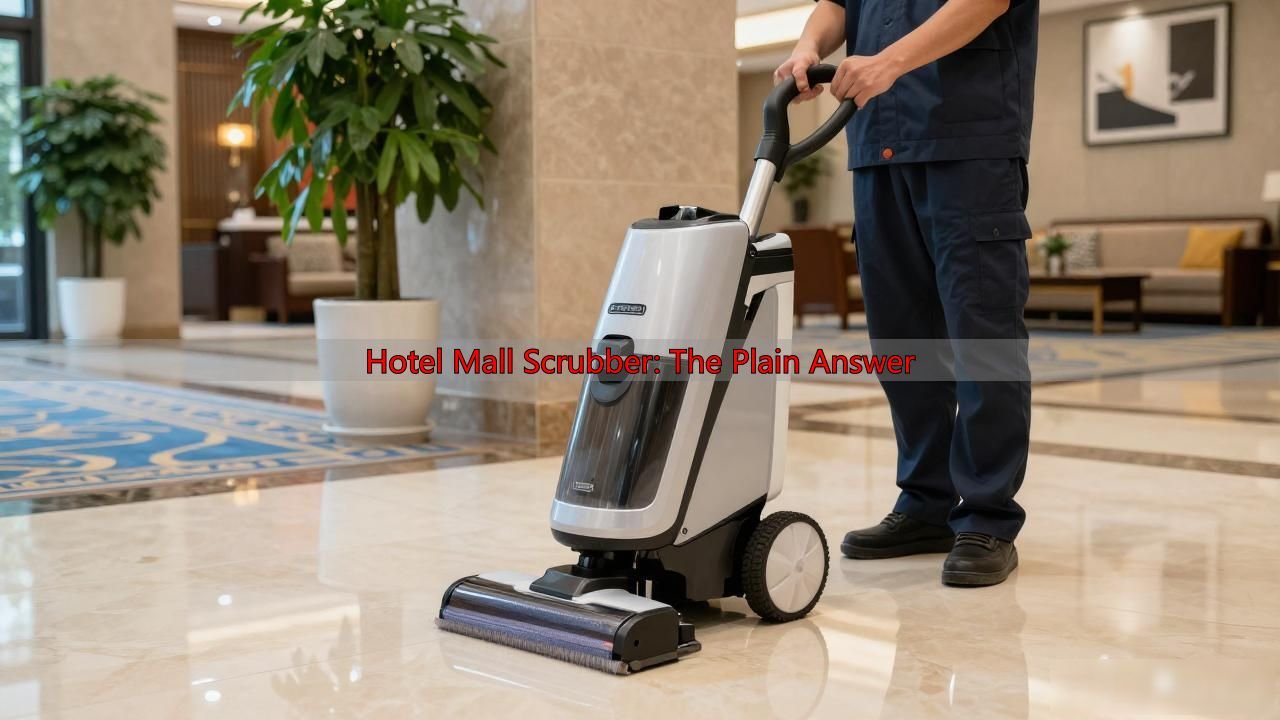
A question often raised, almost testily, by procurement teams: "Why not buy locally? Every city has a janitorial supplier." And the answer, calm and unadorned: because a locally-sourced generic scrubber at the same price point typically sacrifices squeegee width, sacrifices battery chemistry, sacrifices the frame's corrosion resistance. The Tanjie International unit arrives with a 304 stainless steel tank, a polyurethane squeegee not rubber but polyurethane, a brush deck that adapts to granite, to terrazzo, to polished concrete, to the imported limestone so many boutique hotels insist upon. You are not buying a machine. You are buying a floor system. The machine is merely the visible half.
The contrast, laid side by side: a hotel mall operating on a five-year replacement cycle with generic units versus one on a ten-year cycle with engineered scrubbers. The arithmetic is not subtle. Fewer replacements, fewer downtime days, fewer chemicals consumed per square meter, fewer calls to a technician who cannot come until Thursday. The guest never sees the invoice. into the restaurant on the mezzanine. That is the entire argument, and it requires no data table to prove it. You walk in. هل ترى. You know.
And so the buyer, the hotel operations director, the mall facility manager reading this on a Tuesday afternoon between two video calls — the question is not really "should I switch?" export entity, the trading company, the one that ships, the one that coordinates, the one whose name is on the bill of lading you hand to your customs broker. That name carries a service commitment, not just a product.
The floor, in the end, is not a floor. It is the first word a hotel mall speaks to every person who steps through its doors. Three hundred guests per hour. Three hundred first impressions, stacked, daily, a thousand times a year. You cannot put a first impression in a press release. You put it in the polish underfoot.
That is what a floor scrubber is, truly. Not a janitorial appliance. A silent editor, trimming the rough edges of a day, so the next three hundred guests walk in and see only the gleam, and never the four o'clock dust.