 شركة انهوى تانجي للتجارة الدولية, المحدودة.


Stop. Before you assign another two-man crew to rake gravel off the staging area—imagine the machine that swallows it in forty minutes flat.
Marcus, a site supervisor in Wuxi, put it without fluff: "I lost three lads to dust inhalation last quarter. The sweeper paid for itself in a week." His words, taped to the break-room wall, still carry weight.
But what makes a construction site different from a municipal parking lot?
Not gentle surfaces. Not predictable debris. What you face on a job site is a tangle of rebar stubs, concrete chips, and wet clay—think of it as a junkyard that learned to wear a hard hat.
◆ Why Standard Sweepers Fail on Sites
A lot-maintenance unit assumes 5 mm leaf litter and dry asphalt. A site assumes:
Particle size: 40 mm rebar shards versus 5 mm lot leaves
Ground: uncompacted fill, 3% grade, no firmness
Operating window: often under 6 hours before pouring
Mismatch the spec and the machine clogs, stalls, or simply cannot reach the edges.
◆ Data You Can Take to the Board
أ 2024 CIP (Construction Industry Publishers) survey of 340 mid-size contractors found 62 % still rely on hand tools for site clearing. Cost per shift: $3,200 in labor and PPE. A single industrial unit from Tanjie: $480 per shift equivalent. The arithmetic is not close.
So which specs actually matter on-site?
Read the right-hand column as a floor, not a ceiling.
◆ Sweep-tivity: The Number That Matters
Here the language shifts. Tanjie's R&D team coined the term swep-tivity —sweep rate per square meter per hour, adjusted for debris density and moisture. It is the single KPI your operations lead should chase, not raw horsepower.
What swep-tivity governs:
+ Brush RPM (minimum 2,200 for wet clay)
+ Bristle material: polymer for concrete dust; steel-wire for rebar
+ Site moisture cap: 45% wet basis before efficiency drops
+ Motor class: IE3 minimum
+ Bin discharge: end-loader for tip-trailers; top-hatch for compactors
− Gravel feed angle: keep under 18° to avoid under-carriage jam
One unit, tuned right, swallows 12,000 m² of slab pour zone in under an hour.
◆ A Hefei Pour, Told by the People There
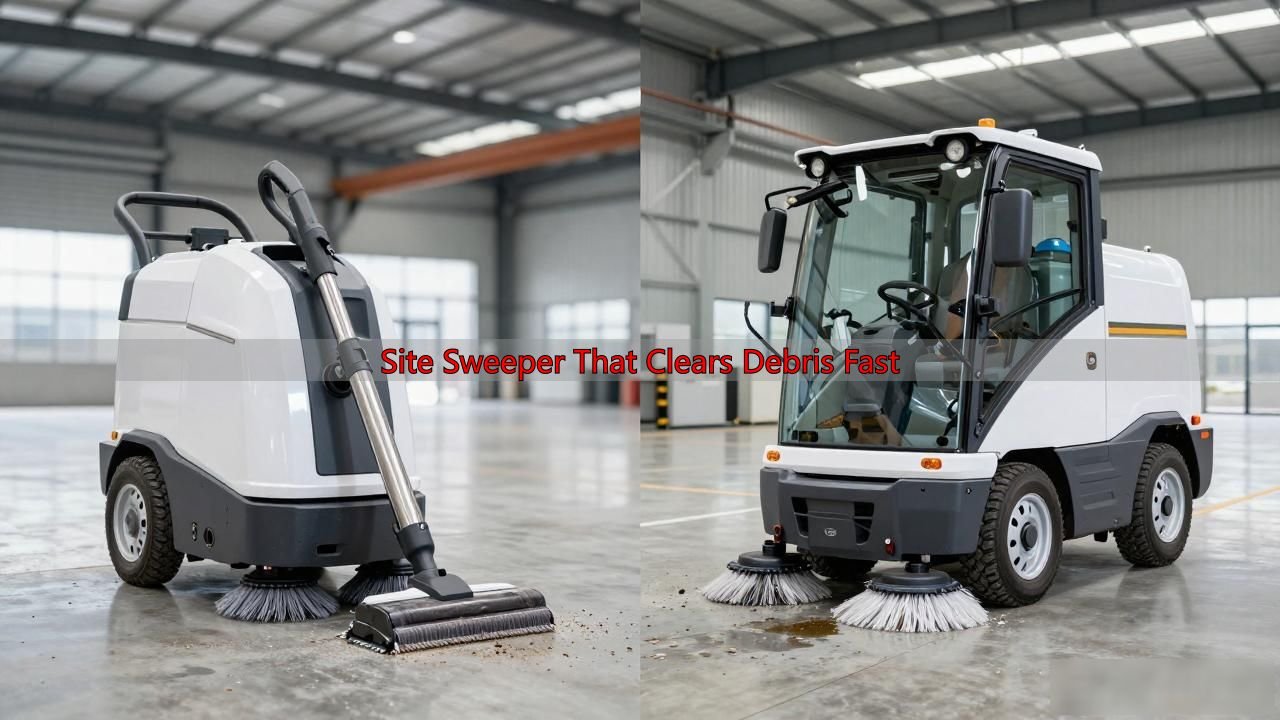
A Tier-1 developer piloted Tanjie's TJ-SV8500 on a 12,000 m² tower-slab pour in March. The log:
Cleanup time: 3.2 hours → 42 minutes
OSHA-equivalent dust incidents (quarter-on-quarter): 7 → 0
Labor hours saved per pour: 11
Tire punctures over 60 site-days: 0 (solid-core)
The foreman's note, still taped inside the cab door: "Runs like a diesel that learned manners." The operator, 23, signed it under the line: "First machine I've driven that does not fight me."
◆ The P&L View
For the finance director: ROI crosses ten months on two weekly deployments. After that, the unit prints margin. Your environmental-compliance file—your local environmental checklist—clears in one line: "Mechanical dust control: certified, unit ID logged." No more back-and-forth with the district bureau.
◆ What the 2028 Roadmap Looks Like
بواسطة 2028, Tanjie's internal blueprint shows LiDAR-mapped auto-path sweepers. No operator. The machine ingests the site plan from your BIM export, plots its route, executes, and reports debris weight to your ERP by 06:00. The word "sweeper" will sound quaint, the way "dial-up" does today. The unit will be a node Industrial sweeper for construction site , not a machine.
◆ TheAsk
One email. One call. Tell us your site area, your pour schedule, and your current dust log. We map the unit to your spec within 48 hours and send the swep-tivity model so your team can benchmark before we ship.
The next site you walk should not have gravel crunching under your boots. It should hum.
Make the call this week. The pour will not wait.