 Anhui Tanjie International Trade Co., Ltd.


The dust on your loading dock is not just an eyesore—it is a silent tax on your floor life, your worker safety record, and your quarterly maintenance budget. By 2027, the global industrial cleaning equipment market is projected to cross the nine-billion-dollar mark, and a very large slice of that growth is flowing straight into walk behind industrial sweeper segments, because factory owners and logistics operators are finally realizing that dragging a push broom across four thousand square meters of concrete is not a viable long-term strategy. So here is the question that every operations manager in a mid-size plant is quietly asking right now: which walk behind industrial sweeper actually earns its keep on a Tuesday morning shift, and which one just becomes another expensive paperweight in the equipment yard?
Let us walk the timeline, because the story of the walk behind sweeper is not a new one. Decades ago, the concept was born out of a very practical constraint: ride-on machines simply could not fit under low overhead pipe racks, into narrow aisles between pallet racks, or through the doorway of a small parts-remediation bay. The walk behind sweep industrialer was the answer to that spatial squeeze. Fast forward to the present cycle, and the design language has shifted dramatically. Modern units now pack brush-roller combinations with adjustable down-pressure Kráčejte za průmyslovým zametačem , high-capacity hopper systems rated at two hundred liters or more, and vacuum motors that pull particulate down to a sub-thousand-micron range without the operator having to lean in and check the floor twice. The contrast is sharp when you line up a legacy unit from the early 2010s next to a current-generation model: the older machine sweeps in a narrow strip, kicks up a visible plume of fine dust at the rear, and demands a hopper empty every forty-five minutes. The newer unit gobbles a full 1.2-meter swath in a single pass, seals the debris bed under a low-suction plenum so the floor looks clean from three meters away, and lets the operator coast for two full hours before the hopper hits its sensor threshold. That is not a minor upgrade; that is a different class of tool entirely.
This is where the data argument gets concrete, and it is where Anhui Tanjie International Trading Co., Ltd.—the export arm of Anhui Tanjie Environmental Technology Co., Ltd.—has been quietly building its reputation across the Southeast Asian, Middle Eastern, and South American distribution channels. Their walk behind industrial sweeper line spans three principal configurations, each tuned for a different floor-load scenario. The light-duty unit targets facilities with fine particulate like flour, powdered coatings, or textile lint, pairing a dual-brush front assembly with a softer bristle density so the material does not shed back into the air. The mid-range model, which is arguably the workhorse of the lineup, handles mixed debris: wood chips, metal filings, wet paper sludge, the usual mess of a composite workshop. It runs on a battery platform that, on a single charge, delivers roughly five hours of continuous sweeping at a walk pace, which covers a typical two-shift operation in a 3,000-square-meter warehouse without a mid-shift battery swap. The heavy-duty variant throws in a wider roller, a reinforced chassis, and a hopper that tolerates sharper corners and denser debris without binding. What unites all three is a design philosophy that the Tanjie engineering team has repeated in every trade-show demo they have done: the operator should not have to fight the machine. The handle height, the steering pivot, the bristle tension knob—everything sits within a natural arm's-reach envelope so the sweep path stays smooth and the operator's shoulder does not lock up after two hours.
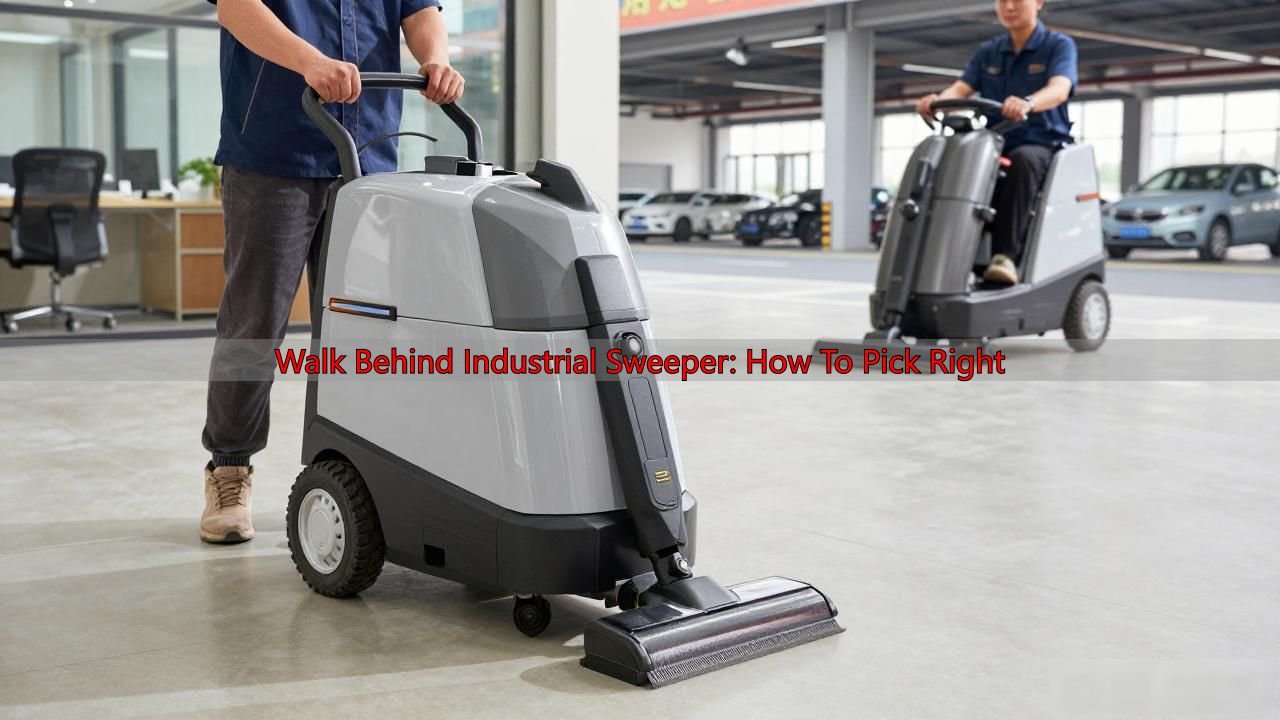
Teď, a causal chain worth tracing. When a facility upgrades from a broom to a proper walk behind industrial sweeper, the immediate effect is throughput: a floor that used to take forty minutes of manual sweeping now clears in under fifteen, and the worker who was doing it is redeployed to a value-adding task. The secondary effect is compliance. OSHA and equivalent regulatory bodies in the EU and GCC markets have tightened indoor air-quality and housekeeping standards over the last three years, and a sealed vacuum system on a walk behind sweeper keeps suspended particulate out of the breathing zone in a way a push broom simply cannot. The tertiary effect, the one that shows up on the P&L six months later, is floor maintenance cost. Consistent removal of abrasive grit means the concrete or epoxy surface retains its finish longer, which means the re-coat or re-grind cycle slides from every eighteen months to every thirty months. Multiply that across a plant with two or three floors, and the sweep-up budget does a lot of quiet work for the finance team.
There is a tension, though, and any honest buyer's guide has to name it. A walk behind industrial sweeper is not a one-size-fits-all solution. A high-volume container terminal with a million square meters of open yard is going to reach the ceiling of what a walk-behind unit can handle before lunch, and the right answer there is a ride-on unit or a municipal-style sweeper. The walk-behind format shines in the 200-to-5,000-square-meter range, where the footprint is tight, the traffic density is moderate, and the operator can stay inside the workspace throughout the sweep without walking back and forth to a staging area. Acknowledging that ceiling is not a weakness in the product; it is a boundary condition that makes the specification honest.
Looking ahead, the next two product cycles will likely fold in two things that are already at the prototype stage in several Chinese manufacturing hubs. The first is a lightweight LiDAR or ultrasonic obstacle ring around the hopper, so the sweeper can be set to a slow autonomous pace for the overnight pass while the human operator handles the morning spot-check. The second is a consumable telemetry chip that pings the maintenance department a low-battery or low-bristle-wear alert before the unit actually stops, turning a reactive "machine is down" phone call into a scheduled parts swap on the next day. Anhui Tanjie has flagged both of these on its 2026-to-2027 product roadmap, and the export catalog through Tanjie International is already reflecting early-bird pricing for buyers who lock in before the first production batch ships. The walk behind industrial sweeper is not a fad and it is not a niche; it is the default answer for the vast middle of the industrial floor, and the next few years are going to make that default noticeably smarter, quieter, and cheaper to run than anything on the market today. The floor is clean, the air is better, and the shift ends on time—those are not small promises, and the walk behind industrial sweeper, done right, keeps every single one of them.