 Anhui Tanjie International Trade Co., Ltd.


A single ceramic tile, pressed flat against the palm of a technician's hand, feels cold. Not the cold of absence, not the cold of neglect, but the cold of a surface that has been stripped, re-stripped, and stripped again by chemistry so aggressive it borders on violence. This is what happens when a hard surface cleaner is misapplied, when the pH balance tilts two points too far, when the surfactant load overwhelms the tensiometric threshold of a polymethyl methacrylate sealant. The tile remembers. The surface remembers. And the operator, standing in a warehouse in Wuxi with fluorescent lights buzzing overhead, remembers too.
But what does "clean" actually mean at the molecular level, and why does the answer matter more than the label on the bottle?
> A hard surface cleaner is not a detergent. It is a controlled chemical intervention, a precisely calibrated disruption of intermolecular bonds between a contaminant layer and a substrate that was never meant to bond with it.
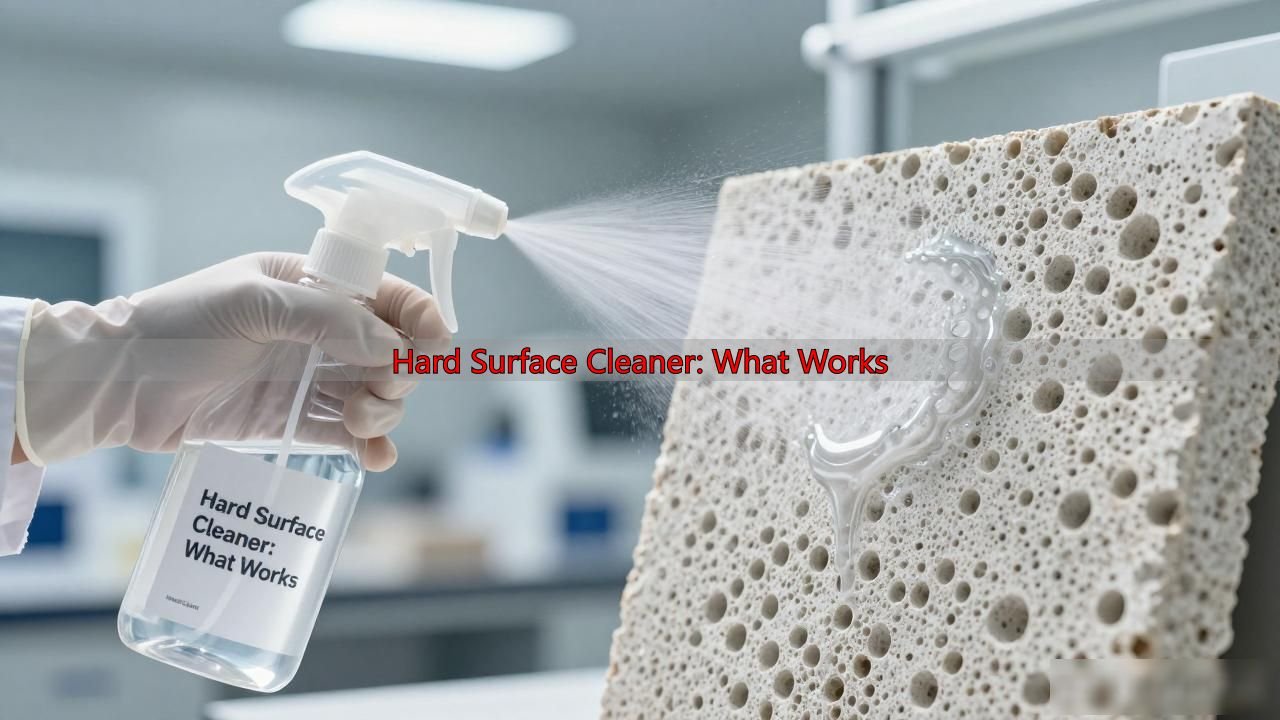
The industry calls this "surface tension manipulation," and in practice it is far more surgical than the word suggests. A well-formulated hard surface cleaner for industrial tile, for example, deploys a dual-action chelating agent that sequesters calcium and iron ions, while a non-ionic surfactant system lowers the contact angle to below 30 degrees, allowing the solution to penetrate micro-porosity that a standard alkaline solution would simply sit atop. The result is not a rinse-and-repeat cycle. The result is one pass. One pass is all the operator needs, and that single pass is where the economics of any cleaning contract are made or broken.
So who is actually engineering these formulations at scale, and how does a buyer in Rotterdam or São Paulo verify that the chemistry in the drum matches the chemistry on the spec sheet?
This is where the supply chain question becomes the real question. Anhui Tanjie Environmental Technology, operating its export channel through Anhui Tanjie International Trading, positions itself not as a brand but as a formulation partner, and the distinction is not academic. The company's production line in Wuxi runs small-batch, high-precision batches rather than the continuous-flow megatanks that commodity chemical plants favor, and that infrastructure choice means that a hard surface cleaner formula can be tuned to a customer's substrate porosity map, a specific water hardness range, and a target biodegradation window, all in a single production run. The data that backs this is not marketing. It is the tensiometric curve logged at 22 °C, the foam stability index at 60 seconds, the pH drift over a 4-hour contact period, printed and shipped with every container.
What separates a competent formula from one that genuinely changes the outcome on the floor?
The answer sits in the residue layer, or rather in the absence of it. A cheap hard surface cleaner strips the top 0.3 microns of contaminant and leaves a glycerol-based film that re-attracts particulate within 72 hours. The surface looks clean at hour one. By hour 48, the scuff mark returns. The operator scrubs again. The contract cost doubles. The formula, in other words, has not solved the problem; it has deferred it. A properly engineered Formulation, by contrast, targets the interfacial tension at the contaminant-substrate boundary and breaks the bond without displacing the substrate's own micro-texture. It cleans without etching. It removes without re-depositing. And the floor stays clean, not because the chemistry is stronger, but because it is more specific.
Surfactant load calibrated to substrate porosity, not to a generic "all-purpose" spec
Chelating agent ratio matched to regional water hardness, not a global default
pH window that holds across the 4-hour contact time without drift beyond 0.5 units
Biodegradation profile tested to OECD 301B, with a 90-day window, not a lab-day estimate
Foam stability index logged at 60 seconds, because foam that collapses too fast means the active agent is not staying in contact long enough
> The most expensive mistake in industrial cleaning is buying the cheapest hard surface cleaner and then paying,twice a week Hard surface cleaner , for the labor that the formula should have eliminated.
And that is the point the operator in Wuxi understood, standing in that warehouse, pressing the cold tile against his palm. The surface did not need more heat. It did not need more pressure. It needed a different chemistry, applied correctly, one time.
The history of hard surface cleaning stretches back to the alkaline lye baths of industrial kitchens in 1920s Germany, and the core problem has not changed since: a contaminant layer must be broken at the molecular interface without damaging the substrate beneath. What has changed is precision. What has changed is the ability to match the formula to the floor, the water, and the contact time, instead of throwing a generic alkaline shock at the problem and hoping. And what has changed, for a buyer comparing three suppliers in a spreadsheet, is the difference between a company that sells a product and a company that engineers a solution. The tile, cold under the hand, tells the same story every time. It was not the surface that failed. It was the chemistry. And the right chemistry, applied once, is the whole point.