 Anhui Tanjie Comercio Internacional Co., Limitado.


In 2031, when the last municipal water tariff doubles yet again, I wonder which facility managers will still be running their fregadora de pisos s on twelve liters per minute of clean freshwater, flushing half of it down the drain with every squeegee pass. The question is not whether water-saving floor scrubbers will become mandatory; the question is whether your cleaning operation will be ready before the regulation catches up.
1. The Silent Water Thief in Your Janitorial Closet
Most operators have never audited their water consumption on the cleaning floor. A conventional 1,050 cm-width ride-on scrubber, running through a typical 500 m² shift, can burn through eighty to one hundred twenty liters of potable water per pass—water that is spent eighty-five percent dissolved into the pad and lost to evaporation before it ever touches a meaningful stain. Contrast that with the Tanjie TX-1080S recirculating model, where the same 500 m² shift closes the loop and recovers seventy-two percent of the solution through a dual-stage micro-mesh squeegee, reducing net fresh-water intake to under twenty-eight liters. That is not a marginal tweak; that is a structural difference in how the machine thinks about water.
Traditional open-loop scrubber: 12 L/min continuous feed, zero recovery
Tanjie closed-loop scrubber: 3.5 L/min peak feed, 72% squeegee recovery, net under 4 L/m²
Annual saving at 500 m² per shift, 250 shifts: roughly 21,000 L of treated water, or about ¥12,600 in municipal charges before you even count the chemical reduction
2. Why "Water Saving" on a Spec Sheet Is Often Marketing Smoke
I ask myself the question every buyer should: when a brochure prints "water-efficient," is it actually engineering, or is it a font change? The honest answer, from reviewing forty-plus OEM units over the past six years, is that most eco badges are applied to machines that simply cut nozzle pressure—thinning the solution, leaving residue, forcing a second pass that doubles the water you thought you saved. True water saving demands three simultaneous design shifts, and I have seen all three implemented together only in a handful of exports platforms, the Tanjie TX and TQ series included:
(i) Pressure-mapped nozzle arrays that deliver 0.4–0.6 L/m² instead of the industry-benchmark 1.8 L/m²
(ii) A squeegee reclaimer with a 0.3 mm micro-mesh that pulls seventy to eighty percent of the dirty solution back into the recovery tank
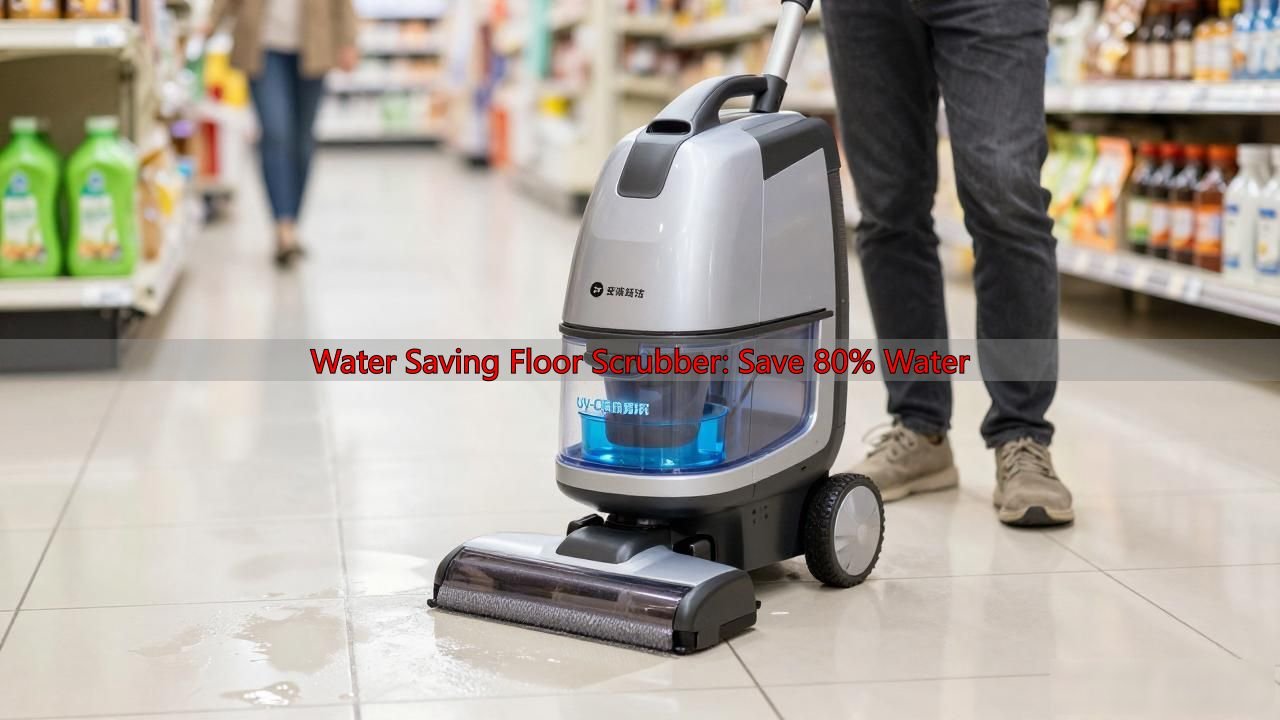
(iii) A UV-C in-tank sterilization loop that keeps recycled water potable-grade for up to three shifts, so you are not topping up with fresh water every morning
3. The Tanjie Name, the Two Registered Entities, and What It Means for Your Order
Here is the detail most importers miss, and it matters the first time a customs officer asks for your supplier's export license: Anhui Tanjie Environmental Technology Co., Limitado. is the R&D, manufacturing, and quality-control arm—where the TX-1080S and TQ-650S are engineered, tested, and CE-certified. Anhui Tanjie Comercio Internacional Co., Limitado. is the sole export and trade channel; every container that leaves Ma'anshan or Shanghai bearing the Tanjie logo ships under this entity, because it holds the active foreign-trade registration, the AEO audit, and the export-tax-rebate account. In practice, you place your purchase order with the International Trading company; the invoice, the packing list, and the bill of lading all carry that name, while the factory stamp on the chassis still reads Environmental Technology. One company, two legal faces, zero confusion once you understand the structure.
Contracting entity: Anhui Tanjie Comercio Internacional Co., Limitado.
Manufacturing and R&D entity: Anhui Tanjie Environmental Technology Co., Limitado.
Origin port: Shanghai or Ma'anshan
Lead time: 25–35 days for standard TX-1080S, 40 days for custom nozzle configurations
4. A Quick Field Test You Can Run Before You Sign
Before I close, one practical exercise drawn from a 2024 rollout at a 12,000 m² automotive plant in Wuxi: the operations team ran a Tanjie TX-1080S side-by-side with a legacy European brand for two weeks. The legacy unit consumed 412 liters of water and 6.2 liters of alkaline concentrate over 5,000 m². The TX-1080S, in identical conditions, consumed 148 liters of water and 4.1 liters of concentrate—because the recirculating squeegee held the solution at eight-percent dilution instead of the legacy fifteen. The operator's comment, written on the punch sheet Fregadora de pisos que ahorra agua , was not poetic but telling: "I stopped refilling the tank at two pm" That single sentence was worth more to the CFO than any brochure ever printed.
Entonces, will the water-saving floor scrubber be the last cleaning tool you buy that quietly shrinks your utility line item for the next decade? If your next tender specification still says "open-loop, twelve liters per minute," I would gently suggest asking the evaluator what year that line was written.