 Anhui Tanjie Comercio Internacional Co., Limitado.


You have sourced through middlemen. You have overpaid. You have accepted a mediocre machine because the chain between factory and dock concealed the truth from you. Reverse that equation, now. Pull the scrubber to the source. Pull it to the floor where it is welded, wired, and test-run before the container seal is stamped.
An industrial fregadora de pisos , stripped to its essence, is a machine built to clean, agitate, and dry a hard-surface floor in a single forward pass. Almacenes. Distribution centers. Aircraft hangars. The working width of these units spans from two meters to twelve meters, and the scrub-throughput—square meters per hour—decides whether your crew of thirty finishes before the inbound trucks arrive. ride-on reaches 8,000 m²/h and beyond. The gap is not decorative. It dictates headcount, cycle time, and the operating cost per square meter across the entire fiscal year. What you buy at one tier and what you buy at the next are not the same tool wearing a different badge. They are different instruments, solving different physics.
One name requires your attention: Anhui Tanjie Comercio Internacional Co., Limitado. , the export face of Anhui Tanjie Environmental Protection Technology Co., Limitado. One entity. Two registration names. The domestic assembly line answers to the environmental-technology name; the container ship, the purchase order translated into three languages, the customs declaration in Hamburg or Dallas, answers to the international-trading name. This is not a trading house layering a margin on someone else's product. voyage. Over two decades of manufacturing, the production line has shipped ride-on and walk-behind scrubbers to forty-six countries, and the export ledger carries no white-label entries. Every unit carries the Tanjie chassis, the Tanjie drive, the Tanjie warranty code.
Why does that two-name structure matter to you, the procurement lead in Rotterdam or in a bonded zone in Shenzhen? Because each intermediary in the chain adds a margin on top of a margin. A scrubber whose factory cost is 4,200 USD exits a regional distributor's warehouse at 5 Wholesale industrial floor scrubber ,900 before it clears your dock. Strip the intermediary, and that identical machine lands at 4,350. Across a fleet of twelve units, the delta is not a rounding error. It is a line item that reshapes your annual capital plan. The factory price is the floor of the market. Everything above it is someone else's profit, not the machine's value.
The specifications, stated plainly, for your evaluation:
Brush and pad system : Double-brush or triple-brush configurations; squeegee width matched to floor area; pads and squeegees replaceable at the operator station without lifting the hood.
Battery architecture : Lithium iron phosphate cells, 48 V or 60 V, eight to ten hour pad-cycle per charge, zero memory effect, five-year rated service life under normal depth-of-discharge.
Recovery and clean-water tanks : 40 L on the compact rider up to 320 L on the high-speed ride-on; hot-swappable modules for uninterrupted shift work.
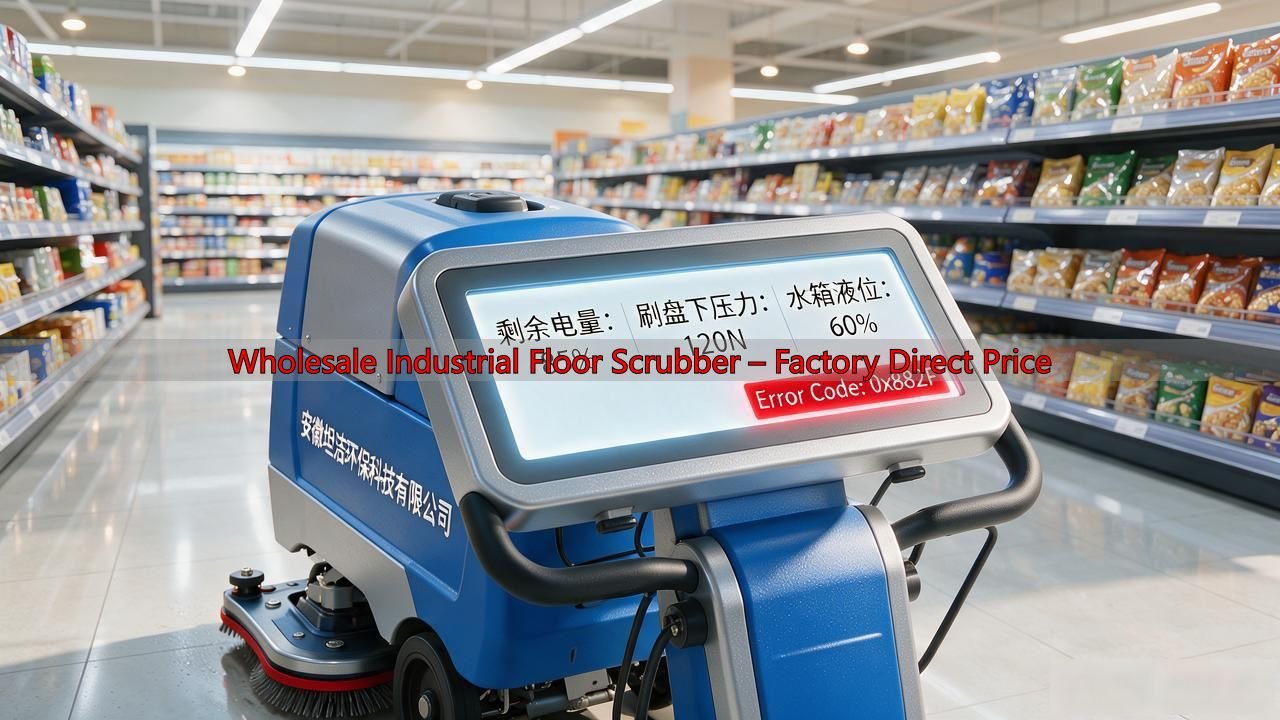
Control and diagnostics : LCD panel showing remaining charge, brush down-pressure, and tank level; fault codes visible to the operator, not buried in a 200-page service binder.
Chassis and corrosion rating : Galvanized steel frame, powder-coat finish, rated for detergents up to pH 12.
Warranty and parts : 24 months on drivetrain and electronics; 12 months on consumables; spare parts dispatched from the factory within 72 hours of a confirmed order.
The causal chain is short and unambiguous. You purchase at the factory price, and your capital expenditure drops by eighteen to twenty-five percent against the same machine procured through a regional distributor. That saving does not vanish into the machine. It returns to your balance sheet as a second unit, a shorter depreciation window, or a wider margin on the cleaning service you resell to your end customer. The scrubber does not clean differently because of who printed the invoice. on the recovery fan—these are identical from unit one to unit two thousand. What changes, and changes only, is the number of hands that touched the price before it reached you.
A caution, stated without softening. The wholesale market for industrial floor scrubbers is not uniform, and it will not be for some time to come. White-label units flood the generic listings on large B2B platforms. A machine branded "industrial grade" may carry a 350-watt brush motor relabeled as 800. A "lithium" pack may be a repackaged lead-acid cell with a four-month life under hot conditions. The sticker-price gap between a genuine factory unit and a mislabeled clone looks modest at the point of purchase—perhaps six hundred USD per machine. The true cost surfaces in year two, when the clone's motor seizes, its "lithium" pack dies, and your downtime stretches into weeks while the factory-spec Tanjie unit still runs its eight-hour shift without a service call. The warning is not theoretical. It is written in the failure logs of every distributor who tried to source a cheaper unit and then spent the next two years paying for it.
The history here is brief but instructive. Twenty years ago, the industrial scrubber was a walk-behind, gasoline-powered, single-operator device that cleaned two thousand square meters a day and fouled the air it was supposed to purify. The shift to electric, to ride-on, to lithium-ion happened in a decade. The next decade, now unfolding, belongs to connected machines—telematics on the drive unit predictive, pad-cycle alerts sent to a phone before the brush wears thin, firmware updates pushed over the air. The factory that ships a standard unit today must also be the factory that ships the next one without asking you to retrain your crew.
The path forward is two emails and one video call. You send a specification sheet: floor type, total area, shift pattern, detergent pH, target throughput. The engineering desk at Anhui Tanjie responds within one business day with a matched model, a landed-cost breakdown to your port, and a container schedule. No negotiation theater. No "let us circle back." The factory price is the factory price, and it is printed on the quotation that reaches your inbox that same evening.
The floor is large. The deadline is fixed. The only variable still open in your equation is who built the machine that will scrub it. Choose the hand that welded it. Choose the hand that stands behind the warranty code for twenty-four months and then for the next five. The rest of the chain can stay on the other side of the ocean.