 Anhui Tanjie International Trade Co., Ltée.


The dust settles. Or it doesn't. On a job site in Houston, Texas, a 4-ton pile of drywall shavings just refuses to budge. The foreman's boot kicks it. The shavings scatter wider. His whole crew stops. Nobody's moving bricks. Nobody's pouring. Everyone's just staring at that gray smear and muttering the same sentence: "We need a sweeper."
Fast-forward to a site in Rotterdam, 2024. Same problem, different continent. The sweeper that saved that Dutch crew wasn't some fancy robot. It was a compact industrial unit, wheeled in at dawn, running two continuous passes before the foreman's coffee went cold. By 9 am, the concrete pad was clean enough to pass inspection. That's the thing nobody tells you in product brochures: on a construction site, the sweeper doesn't just clean. It keeps the whole schedule from eating itself alive.
So what does a construction site sweeper actually do that a leaf blower or a broom can't?
The Sweeper's Job, Broken Down
A construction site throws a specific mess at you. Not household dust. Not garden clippings. We're talking:
Dry debris
Concrete dust, up to 10 microns, and it clings to everything
Crushed aggregate and sharp stone chips that'll shred a cheap brush roller in a week
Cement powder, which turns into a slurry the second it touches moisture
Wet+dry mix
Puddle of spilled mortar sitting next to a dry tile offcut
The sweeper has to handle both in one pass without clogging
Bulk volume
A 200 m² slab pour generates enough waste to fill a skip. The sweeper's hopper needs to match that throughput, or you're making four return trips to the dump zone every hour
This is why "industrial" in industrial sweeper for construction site isn't a marketing buzzword. It's a load-bearing spec.
Why You Keep Picking the Wrong Unit
Let me ask you something. When was the last time you measured your site's debris profile before choosing a sweeper? Most operators don't. They grab whatever's cheapest on the invoice, roll it onto the site, and then spend the next three days fighting a machine that was designed for a warehouse floor, not a rebar-strewn excavation pit.
The mismatch shows up fast:
1. Brush diameter too small → slow coverage → the crew wastes half a shift waiting
2. Hopper too shallow → constant emptying → the operator stops cleaning and starts hauling
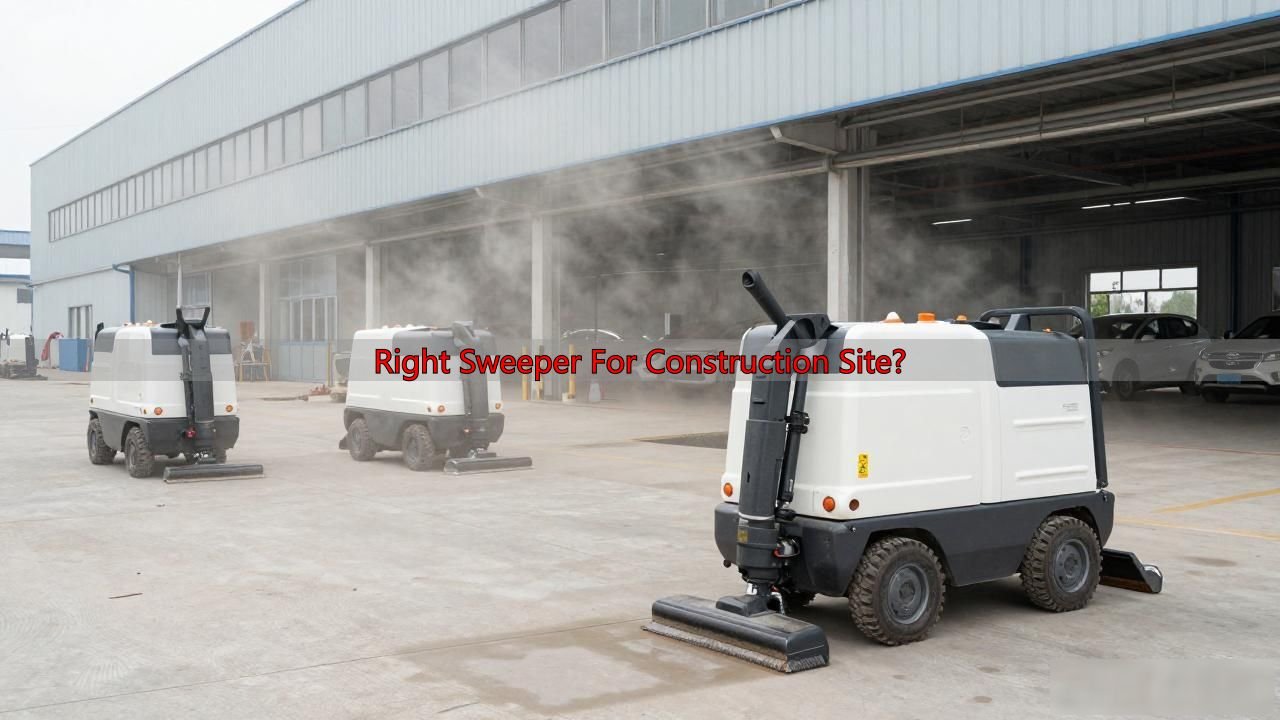
3. Airflow not tuned for fine dust → gray haze rolls back over the inspection line → rework, all over again
A construction site sweeper is a system , not a gadget. Match the three numbers—brush, hopper, airflow—to the three numbers on your site plan, and the unit basically runs itself.
The Tanjie Angle
Here's where it gets concrete. Anhui Tanjie International Trading Co., Ltée. (the export arm of Anhui Tanjie Environmental Technology Co., Ltd.) has been shipping site-grade sweepers into North American and European projects since the early 2010s. Their lineup sits in that sweet spot: not a 2-ton ride-on unit you need a forklift to load, not a handheld blower that'll tire your wrist out by lunch.
What their spec sheets actually look like on a real job:
Compact walk-behind units, 800–1,200 kg, brush width 800–1,500 mm
Dual-mode dust suppression (water mist + HEPA stage) for those OSHA/EN compliance checklists
Modular hopper: swap the 40 L bag for a 120 L bin depending on shift length
Battery options that outlast a standard 8-hour pour window, no generator noise masking the crane comms
One Texas GC, doing a parking-structure deck in 2025, ran two Tanjie walk-behinds in parallel. The foreman's log said it flat: "Two passes, done. No second unit needed. No dust complaint from the tower next door." That's the whole review. No adjectives. Just the log line. It says everything.
A Quick Timeline of What Changed
2015 era: most sites still used compressed air + broom. The sweeper was a "nice to have."
2019: dust-regulation tightening in EU and Gulf markets pushed sweepers from optional to contractual. The industrial sweeper for construction site becomes a line item in the HSE plan.
2023–2026: battery platforms mature. The silent unit replaces the diesel one. Now the sweeper isn't just a cleanup tool; it's the piece of equipment that keeps your site within noise-permit limits after 7 pm
The shift is quiet, but it's permanent. The sweeper's role on a construction site stopped being "sweep up at the end of the day." It's now "run the sweeper, keep the site breathing, keep the inspection coming on schedule."
One Last Question, Left Open
Next time a deck pour is done and the site looks like a storm went through it—grey, gritty, humming with cement fine dust—ask your team one question: Is the sweeper already here Industrial sweeper for construction site , or are we still waiting for it?
The construction site sweeper doesn't care about your schedule. It just bites into the debris, swallows the dust, and empties into the hopper, pass after pass, whether or not you called it in early enough. The dust, though? The dust never waits.
It just sits there, waiting for you to show up with the right machine.