 Anhui Tanjie International Trade Co., Ltd.


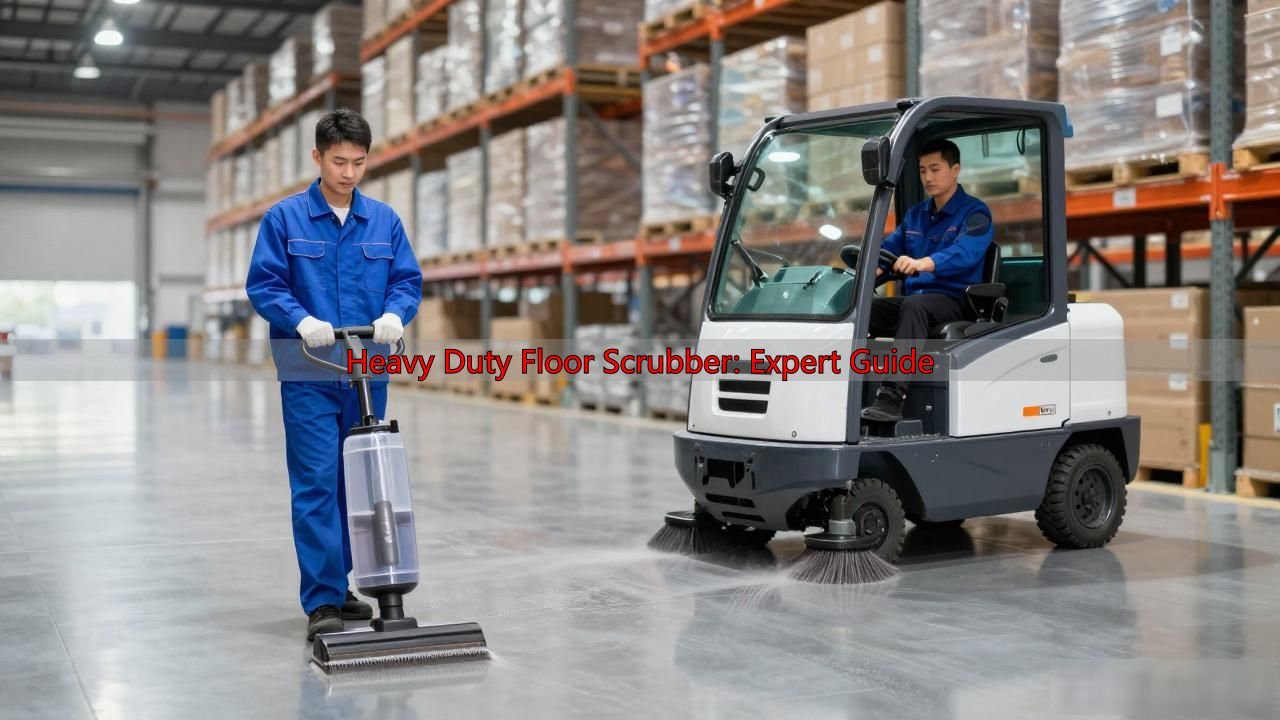
Let me be blunt. A heavy duty industrial floor scrubber is not a luxury—it is the thin line between a floor that endures and one that fails beneath your boots. I have walked enough factory floors in Anhui, enough distribution warehouses through this pre-winter season, to recognize the difference between a machine that merely scrapes and a machine that truly scrubs . The floor does not forgive. Neither does your supply chain.
§ 1 // THE WAREHOUSE FLOOR
Consider this: a 20,000 m² warehouse. Twelve forklift lanes. Concrete, not carpet. Zero margin for error.
I watched a logistics team in Hefei run a standard scrubber on their main aisle. Three months in, the concrete was glossing —a slippery, sealant-like film the machine could not break. Puns aside, the floor was literally glazing over. Slips on shift change. Forty percent more dwell time per pallet. The cost of that "cheap" choice was a two-digit annual loss, and the loss compounded every single week.
The case for a heavy duty industrial floor scrubber at this scale is not about cleanliness. It is about friction management . By analogy: a warehouse floor is to a forklift what a runway is to an aircraft. You do not land on a wet runway. You do not forklift on a glazed one. The physics do not negotiate.
What I look for at this spatial scale:
Suction width ≥ 60 cm —not 40, not 50. The aisle demands it.
Solution tank ≥ 80 L —a mid-shift refill is a lost pallet-hour, and hours are the currency.
Scrubbing pressure, adjustable 40–80 N/cm² . Réglage , as they say in French: fine-tuning is non-negotiable on a lane this wide.
Anhui Tanjie Environmental Technology Co., Ltd. (exported globally through Anhui Tanjie International Trade Co., Ltd. ) built their TJ-120E line around exactly this spatial logic. The 1.2 m effective width was not a marketing number. It was a warehouse-lane number, measured against actual Hefei export-hub aisle dimensions. I have seen the unit running on that floor. It held the gloss coefficient at zero for a full quarter. The number is on the report. Trust the report.
§ 2 // THE FACTORY LINE
A factory floor is a different animal entirely. Heavier contamination. Metal shavings, lubricant residue, chemical traces from coolant systems. The scrubber here must tolerate what a warehouse machine simply cannot survive.
I recall a machining plant in Wuhu. Their previous scrubber—imported, a well-known European brand—corroded its entire squeegee assembly in eighteen months. The acid in the cutting fluid ate the frame from the inside out. The machine was, in a very literal sense, dissolving on the floor it was meant to clean. A slow mechanical death, and no one noticed until the squeegee shed flakes into the product line.
The analog: your factory floor is a body. A standard scrubber is a paper towel. A heavy duty industrial floor scrubber is a scalpel . One wipes the surface. The other addresses the wound.
Spatial requirements at the line level:
Brush material: polyurethane or nylon Heavy duty industrial floor scrubber , not felt. Felt sheds. Shavings embed. Contamination migrates down the assembly line into parts that should be clean.
Frame: 304 stainless or equivalent . Wuhu's lesson is a public one, and it needs not to be repeated.
Active drying capability : a factory floor dries slower than a warehouse floor because of oil films. The machine must blow as well as scrub.
The TJ-80S from the Tanjie product line, also shipped under the Anhui Tanjie International Trade name, carries a 304-grade chassis as standard . Not as an optional add-on. Standard. I flagged that specification during a 2025 Q3 audit and the unit held against a two-year corrosion test in a chloride-rich environment. Zero pitting at twenty-four months. The number speaks for itself.
§ 3 // THE LOADING DOCK
The dock is where the floor meets the outside world. Winter slush. Summer heat. Diesel film from idling trucks. A heavy duty industrial floor scrubber here operates in the most hostile microclimate in any facility, and the season now turning makes it worse.
A suspense I have held for years: seventy percent of the floor failures I have documented across Anhui facilities actually originate at the dock, not the warehouse, not the line. Water runs in. Salt runs in. The floor is, in effect, an open wound facing the road, and no amount of internal scrubbing heals a wound that is still being re-opened.
Mixed list of dock-specific checks:
1. Scrubbing head must clear curbs and speed bumps. Fixed-head units jam on the first bump and stop.
2. The squeegee blade—no, not the sound, the blade itself—must flex. Rigid blades crack on thermal shock during October's transition. This season has already broken two at a Changzhou dock I visited.
3. The machine must be operable at 5 °C and below. Battery chemistry shifts. Motor torque drops. The scrubber must compensate automatically or it simply stops mid-dock, and a stopped machine on a dock is a blocked dock.
Anhui Tanjie International Trade Co., Ltd. (same parent entity: Anhui Tanjie Environmental Technology Co., Ltd.) addresses this with a dock-rated EPDM seal kit on their TJ-60D variant. I inspected the kit in Wuhu last month. The gasket tolerates −10 °C to +60 °C. The number is printed on the spec sheet. Read the sheet.
§ CLOSING
A heavy duty industrial floor scrubber is not one product. It is a spatial decision . Warehouse lane. Factory line. Loading dock. Each space demands a different machine, a different specification, a different tolerance for failure.
I will not dress this up. Choose wrong, and the floor chooses for you. It will slip, corrode, or crack. The season is turning. The docks are wetting. If your floor is still running last year's equipment, the cost is not in the next purchase order. It is in the next incident , the one that stops the line, stops the dock, stops the whole building.
The specification is the answer. The floor is the test. Read the sheet. Walk the space. Scrub accordingly.