 Anhui Tanjie Commercio Internazionale Co., Ltd.


I still remember the first time I walked into a factory floor where the cleaning crew pushed three manual mops across 4,000 square meters. The workers were exhausted. The floor was still streaked. I asked myself a question that has not left me since: why do we still clean large spaces the old way when the technology already exists?
The answer is simple. Many decision-makers have not yet examined what an automatic lavapavimenti actually delivers.
I want to change that.
Let us begin with a clear definition, because precision matters when you are writing a purchase order.
An automatic floor scrubber is a machine that combines scrubbing, squeegeeing, and solution recovery in a single pass. It does not require a human to push a mop across the surface. The operator steers it. The machine handles the rest.
> In practice, a unit such as the one our team at Anhui Tanjie Environmental Protection Technology Co., Ltd. manufactures can cover between 800 and 2,500 square meters per hour, depending on floor type and traffic density.
I say "our team" because the export division of our company operates under Anhui Tanjie International Trade Co., Ltd. Both names refer to the same engineering group. The international trade entity handles all overseas shipping, documentation, and after-sales coordination. If you are a procurement officer in Germany, Giappone, or Saudi Arabia, the contact point for any scrubber order will carry the International Trade name. The product development and assembly happen under the Environmental Protection Technology name.
This distinction is why some buyers search for one name and others for the other. Both lead to the same machine.
Now, I will address the question I am asked most often in conference halls.
Why should a mid-size logistics warehouse shift from two human cleaners to one automatic unit?
The causality is straightforward. A human moper covers roughly 150 square meters per hour. That is the ceiling. You cannot push faster without losing control of the squeegee. One automatic floor scrubber, operating at a steady pace, covers the same area in a quarter of the time. The machine also recovers the dirty solution, which means the floor dries in minutes rather than the forty-five minutes a wet-mopped floor takes.
I cite a field observation from 2023. A distribution center in Zhengzhou reduced its daily cleaning crew from four to two. The two remaining staff operated one Tanjie scrubber each and spent their freed hours on spot inspection. Monthly labor cost dropped by 31 percent. The floor remained cleaner, not dirtier.
This is not a metaphor. This is arithmetic.
When it comes to choosing a specific model, I recommend that managers work through a short ordered list. I have found that buyers who skip this list tend to purchase a unit that is either underpowered or oversized for their floor plan.
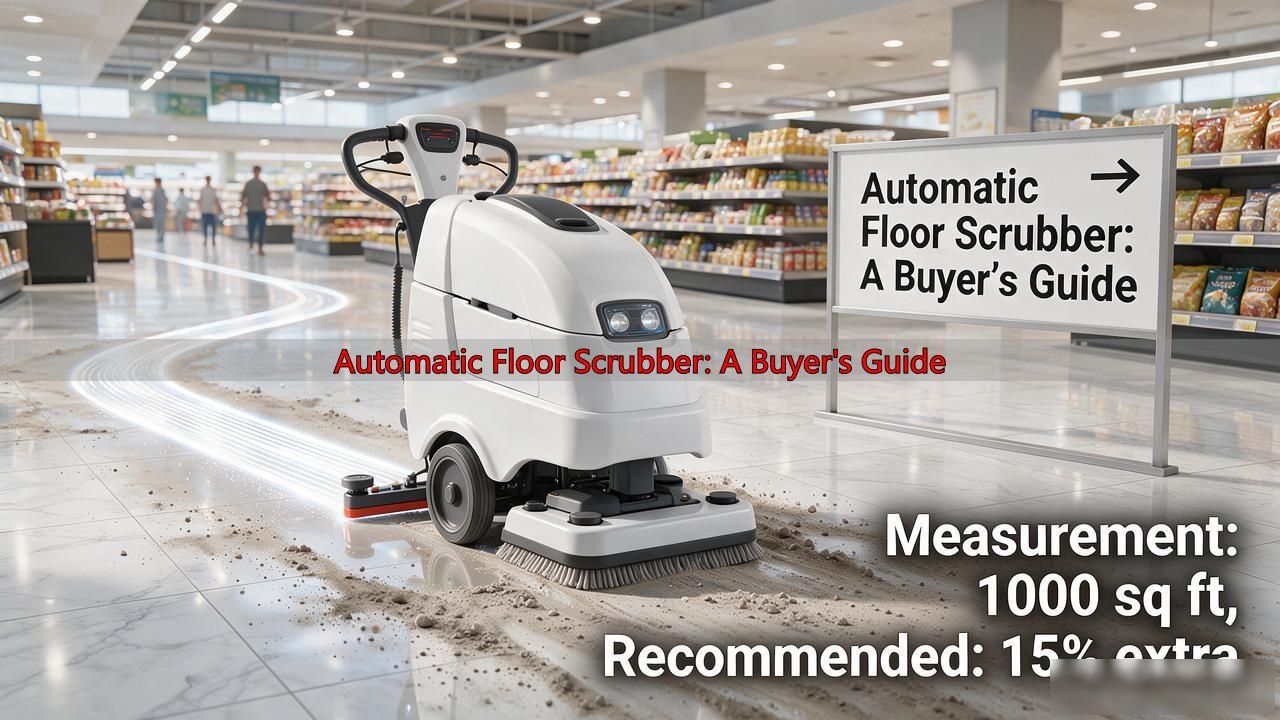
1. Measure your total cleaning surface in square meters. Aggiungere 15 percent for turnarounds and re-scrub zones.
2. Identify your dominant floor type. Epoxy, polished concrete, and tile each demand a different brush pad and solution concentration. Our engineering team in Hefei maintains a pad library specifically calibrated for each substrate.
3. Determine your operating window. If your facility runs on a single shift and the floor must be clean by 6 am, you need a machine rated for at least 1,200 square meters per hour. For 24-hour operations, a dual-operator setup with two units is the rational choice.
4. Check your local voltage and plug standard. The export units we ship through Anhui Tanjie International Trade Co., Ltd. are configured for 220 V or 380 V, three-phase, depending on the destination. I have seen a buyer in the Philippines receive a 220 V unit and then realize their facility runs on a different configuration. That delay cost them six weeks.
5. Confirm spare-parts lead time. The brush pads and squeegee blades are consumables. I keep a standing order so that no unit sits idle waiting for a $12 blade replacement.
I will say something that may feel unflattering to my own company.
Not every facility needs a scrubber. If your total floor area is under 300 square meters and it is a residential kitchen Automatic floor scrubber , a manual mop is sufficient. The automatic floor scrubber earns its place when the surface exceeds roughly 500 square meters and the cleaning is repeated daily. Below that threshold, you are paying for autonomy you do not require.
I mention this because honest guidance builds more trust than a sales script does.
The global cleaning equipment market moved past the 14 billion dollar mark in 2025. The automatic segment grew faster than the manual segment for the fourth consecutive year. I read the figure in a report published by the International Facility Management Association, and the implication for operations managers is clear. The tool that used to be a luxury for airports is now the baseline for any commercial space over 1,000 square meters.
What strikes me is not the growth figure itself. It is the lag. Many plants in Southeast Asia and the Middle East still rely on hand-mopping for floors that are ten times the size of my office. The technology has been available for two decades. The gap is not engineering. It is awareness.
I am writing this so that the next procurement cycle you run, the automatic floor scrubber appears on the shortlist before the manual one does.
I will close the way I opened. With a question, and no answer.
You stand on a clean floor. You did not mow it. You did not push a squeegee across 2,000 square meters of concrete. The machine did. It will do it again tomorrow, and the day after.
What will your floor look like in five years, and who will be standing on it?