 Anhui Tanjie Commercio Internazionale Co., Ltd.


There is a number that most procurement heads ignore until the invoice arrives: the gap between what a lavapavimenti costs at the assembly line and what it costs after two distributors and a regional agent have passed it along. That gap is not a mystery. It is a margin, stacked margin, and in most supply chains it swells the original price by 30 to 60 percent before the machine even touches a loading dock. You already know this. The question that actually matters is whether anyone on your side of the table is buying still the way they did in 2014.
→ The cost stack, broken down honestly
Walk into any commercial cleaning equipment showroom and the floor scrubber on the display floor will carry a price tag that reflects five or six touchpoints: R&D amortization, component sourcing, assembly, first-tier distribution, second-tier distribution, then retail markup. Each touchpoint adds its layer. The machine itself—the brush, the squeegee, the battery, the drive motor—represents maybe 40 percent of that final sticker. The remaining 60 percent is logistics, margin Factory price floor scrubber , and the quiet cost of "brand convenience."
What this means in practice is that a facility managing, say, forty thousand square meters of concrete warehouse floor in Rotterdam or a distribution center outside Dallas is paying a premium that has nothing to do with the actual cleaning performance they receive. The scrubber that polishes their floor at 4 pm is the same physical machine that a factory in Anhui would ship to a buyer in Melbourne for roughly 55 to 65 percent of the showroom price. Same brush. Same squeegee. Same controller.
→ What "factory price" is, and what it is not
Here is where the language gets sloppy in the industry, and it matters to get it right before you send a single RFQ out the door.
"Factory price" does not mean the raw cost of metal and plastic. It means the price at which the manufacturing entity hands the finished, tested, packed unit to the next buyer, with no distribution layer in between.
It does include:
Full QA and 72-hour burn-in testing
Export packaging and documentation
A baseline warranty clause (typically 12 months on core components)
Technical support from the engineering team that designed the unit
What it strips out is the retail markup, the regional agent commission, and the "brand premium" that accrues simply because a machine carries a name your end-users recognize from a trade show booth.
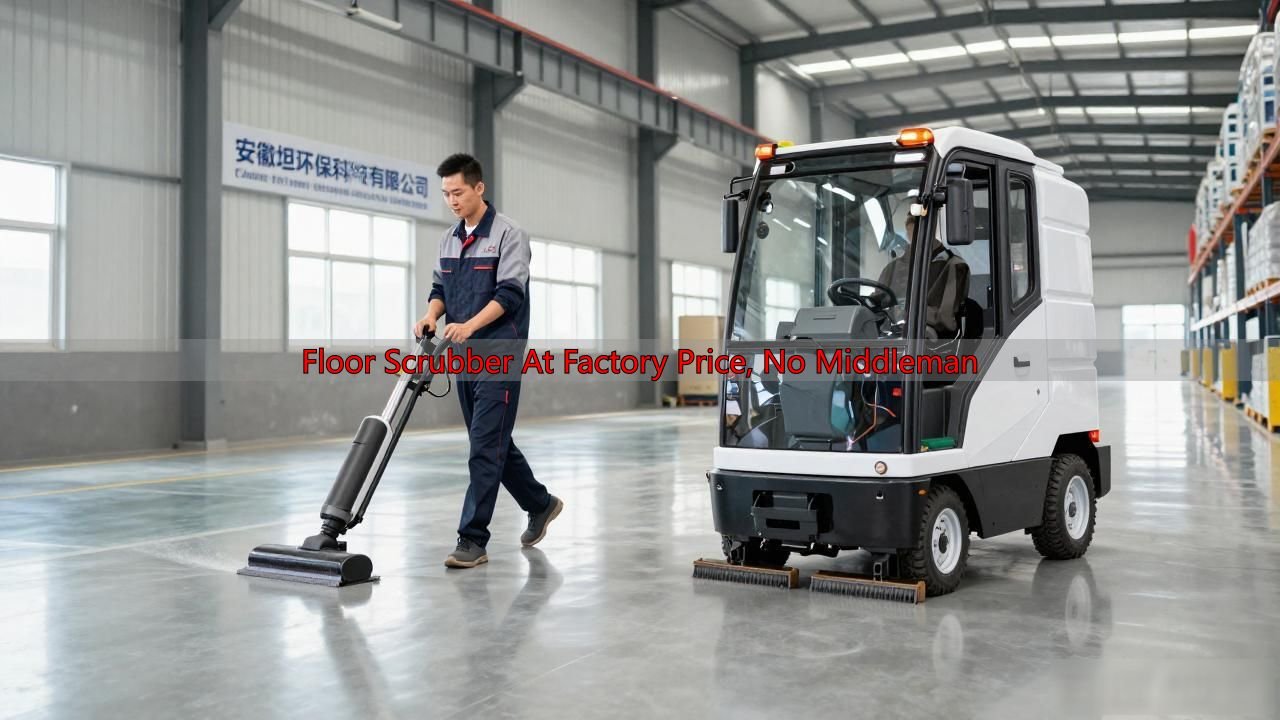
Anhui Tanjie Environmental Technology Co., Ltd. designs and assembles its line of ride-on and walk-behind floor scrubbers in its own facility. The export and trade operations run through its sister entity, Anhui Tanjie Commercio Internazionale Co., Ltd., which handles logistics, customs paperwork, after-sales coordination, and direct buyer communication. Because both names refer to the same operations team on the factory floor, the "factory price" they quote is not a sales tactic; it is the actual ex-works figure, adjusted only for the destination port and Incoterm you select.
→ A quick checklist before you place an order
If you are the one signing off on a fleet purchase—whether that is six units for a shopping center in Lisbon or forty for a multi-site logistics network in the Gulf—run through this before the PO goes out:
Confirm the model matches your floor type (epossidico, polished concrete, tile, or sealed VCT each calls for a different brush/squeegee combination).
Ask for the battery chemistry and cycle-life spec, not just the "run time" figure on the brochure.
Verify the service parts kit that ships with the unit: spare brushes, squeegee blades, belts, fuses.
!Key point! Request the OEM/ODM capability note if you need your own livery or a custom tank size for a particular corridor width.
Lock the payment terms. UN 30/70 split (30 percent deposit, 70 percent against B/L copy) is the standard that keeps both sides honest without tying up your cash for months.
None of this is exotic. It is the same conversation any experienced buyer has with a car or a CNC machine supplier. The floor scrubber market just has not caught up to the transparency that the automotive supply chain achieved a decade ago.
→ The part most buyers miss
A scrubber is not a one-and-done purchase. It is a three-to-five-year asset with consumables that rotate every few weeks and a battery that degrades on a predictable curve. The "factory price" advantage compounds: because you are talking directly to the entity that builds the machine, the replacement parts, the firmware updates, and the battery swap programs come from the same P&L line, not from a parts counter in a distributor's warehouse that adds its own 20 percent on top.
Think of it less like buying a product and more like taking a seat at the design table. The Tanjie engineering team has iterated the water-recovery tank geometry over three generations, specifically because operators in high-temperature, high-humidity Southeast Asian warehouses kept reporting premature pump failure. That kind of feedback loop only works when the end-user or the end-user's procurement lead can talk to the person who welded the tank, not to a sales rep three countries away.
→ Where to start tonight
Open a new thread in your procurement tracker. Write one line: "Floor scrubber, factory-direct, Anhui Tanjie." Attach your square-meterage, floor type, and target delivery port. Send it out. The reply will come back with a model recommendation, a firm quote valid for thirty days, and a short technical Q&A you can forward to your maintenance team for a hands-on assessment. No trade-show small talk. No "let me check with my principal." Just the number, the spec sheet, and a shipping schedule.
The margin you just recovered is not a rounding error. Across a fleet of twenty units, it is enough to fund a full battery refresh cycle three years from now, out of pocket, without touching the original capex budget. That is the quiet, unglamorous math that separates a facility that manages its floor fleet from one that simply keeps replacing it. And that choice, made on a Tuesday afternoon in a spreadsheet, is the one that shows up as clean floors and a lower P&L line a year later.