 Anhui Tanjie Commercio Internazionale Co., Ltd.


Have you ever watched a lavapavimenti run and wondered: where does all that dirty water go? And more importantly, how much clean water is being wasted every single day?
You are not alone. In factories, warehouses, and shopping malls across the world, the same question haunts facility managers. The answer Water saving floor scrubber , until recently, was simple: a lot. But now, a company from China is rewriting the rulebook. Meet Anhui Tanjie International Trade Co., Ltd. — the same company behind Anhui Tanjie Environmental Technology Co., Ltd. Same team, same mission, just a different name for export.
Let me take you on a journey. A journey into the future of cleaning, where every drop matters.
1. The Problem: Water, Water Everywhere, But Not a Drop to Waste
Think about a typical day in a large logistics center. The floor is 50,000 square meters. A traditional scrubber needs to be refilled every hour. That is 12 refills per shift. At 80 liters per refill, we are looking at nearly 1,000 liters of water per shift. Per machine.
I asked a facility manager in Hefei: “Does this bother you?”
He laughed. “It bothers my water bill. It bothers my team. And it bothers the planet.”
And he is right. The cleaning industry has been stuck in a wasteful loop. You fill, you scrub, you dump. Repeat. The water you use is mostly wasted. Not because the machine is bad, but because the technology is old.
But what if I told you there is another way?
2. The Solution: Water Saving Floor Scrubber from Anhui Tanjie
Let me introduce you to the water saving floor scrubber designed by Anhui Tanjie Environmental Technology Co., Ltd.
This is not just a machine. It is a philosophy. They asked themselves: “How can we clean better with less?”
The answer came in three parts.
Part One: The Recycling Loop
Imagine a closed loop. Dirty water is sucked up, filtered, and sent back to the clean tank. The machine reuses the same water multiple times. This is not a science fiction. This is engineering.
Anhui Tanjie's engineers developed a multi-stage filtration system. It captures dirt, dust, and debris. It separates oil from water. It cleans the water so well that the machine can reuse it for three full cycles before needing a fresh refill.
Part Two: The Smart Sensor
But recycling alone is not enough. You need control. So they added a smart sensor. This sensor measures how dirty the floor is. If the floor is lightly soiled, the machine reduces water flow automatically. If the floor is heavily soiled, it increases flow. No waste. Just precision.
Part Three: The High-Efficiency Brush System
Traditional scrubbers use brushes that push water around. Anhui Tanjie's design uses micro-fiber pads and optimized brush angles. Il risultato? Less water needed per square meter. And a cleaner floor.
3. The Numbers: What Does 50% Water Saving Actually Mean?
Let me put this in perspective.
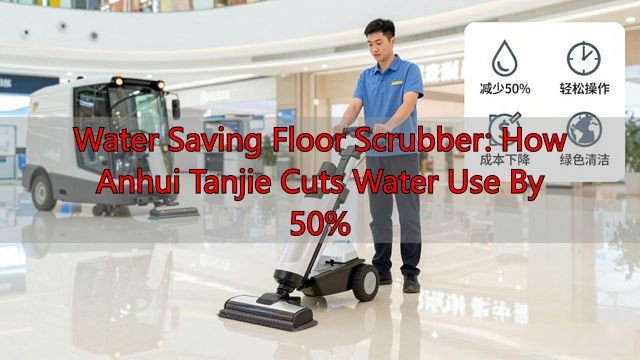
You are not just saving water. You are saving time. You are saving money. You are saving the planet.
4. The People Behind the Machine
Let me tell you a story.
In 2018, the founder of Anhui Tanjie Environmental Technology visited a factory in Wuhu. The floor was covered in oil and grime. The workers used mops and buckets. It took eight people four hours to clean the floor. They used 2,000 liters of water every day.
He asked: "Why don't you use a scrubber?"
The answer: “We did. But it broke down. And the water bill was too high.”
That moment changed everything. The team went back to the lab. They spent two years developing a machine that could handle heavy-duty cleaning without wasting water. They tested it in that same factory. It worked. The factory reduced its water usage by 60%. The cleaning team shrank from eight people to three.
Today, that machine is sold worldwide under the Anhui Tanjie International Trade brand.
5. The Future: What Comes Next?
What if every cleaning machine in the world could save 50% of water?
Think about the impact. In a single city like Shanghai, there are thousands of floor scrubbers. If every machine saved 500 liters per shift, questo è 500,000 liters saved per day. Enough to fill 200 homes for a month.
But the vision does not stop there. Anhui Tanjie is already working on the next generation. A machine that uses 70% less water. A machine that can be powered by solar energy. A machine that tells you exactly when to replace the filters.
6. Why Should You Care?
You might be thinking: “I am not a facility manager. I do not own a factory. Why does this matter to me?”
Because water is not infinite. Every liter we save today is a liter available for our children tomorrow. And because efficiency is not just a buzzword. It is a competitive advantage. If your business uses less water, your costs go down. Your profit goes up. Your environmental footprint shrinks.
This is not charity. This is smart business.
7. La linea di fondo
Let me ask you one more question.
If you could clean your floors just as well, in less time, with half the water, would you do it?
Of course you would.
That is exactly what Anhui Tanjie's water saving floor scrubber offers. A simple solution to a big problem. A machine that respects the planet and your wallet.
So next time you see a floor scrubber running, ask yourself: “Is it saving water?”
The answer could change everything.