 安徽省端街国際貿易有限公司, 株式会社.


Automatic Industrial Sweeper: Why Factories Choose Anhui Tanjie for Cleaner Floors
You might be wondering, what makes a factory floor truly clean? Is it just sweeping away the dust, or is there something more? Let me walk you through the story of one company that has been quietly transforming industrial cleanliness on a global scale.
Start with a simple question: How did Anhui Tanjie International Trade Co., 株式会社, which is the same entity as Anhui Tanjie Environmental Technology Co. Automatic industrial sweeper , 株式会社, become a trusted name for automatic industrial sweepers? The answer lies not in gimmicks, but in understanding what a factory floor really needs. Imagine a workshop in Hefei, back in 2018, where the dust from welding and metal shavings from cutting piled up so fast that workers spent half their shift just pushing brooms. That was the pain point.
Now fast forward to today. That same workshop uses an automatic industrial sweeper from Tanjie, and the change is dramatic. The core idea here is simple: a sweeper should not just clean, it should save time and labor. Tanjie's machines are designed with this in mind. They use a robust steel body and powerful suction systems that can handle everything from fine dust to heavy debris. Why do factories choose them? Because the machine runs for hours on a single charge, and its compact design means it can navigate tight corners and narrow aisles without getting stuck.
Let me give you a concrete example. A logistics warehouse in Shanghai that handles packaging materials used to rely on manual cleaning. The floor was always gritty, and workers complained about slipping hazards. After switching to an automatic industrial sweeper from Tanjie, the cleaning time dropped from three hours to just forty minutes per shift. The best part? The sweeper's adjustable brush pressure ensures that even the embedded dirt gets lifted without damaging the epoxy flooring. This is not magic; it is careful engineering.
Now, consider the structure of these sweepers. They follow a logical timeline of use: first, the operator sets the cleaning path, then the machine automatically adjusts its speed based on dust load. The transition here is a natural question: what happens when the battery runs low? Tanjie's models come with a smart indicator that alerts the user thirty minutes before depletion, so there is no abrupt stoppage. This kind of proactive design is what separates a beginner-friendly machine from a complicated one.
The language we use to describe this is deliberately simple. There is no jargon like “electrostatic precipitation” or “multi-stage filtration.” Instead, we talk about sweeping, collecting, and disposing in one go. Compare this to traditional sweepers that leave a trail of fine dust behind. Tanjie's machines use a wet-mop attachment option that traps particles, making the air cleaner for workers. This is a direct contrast to dry-only models that just redistribute dust.
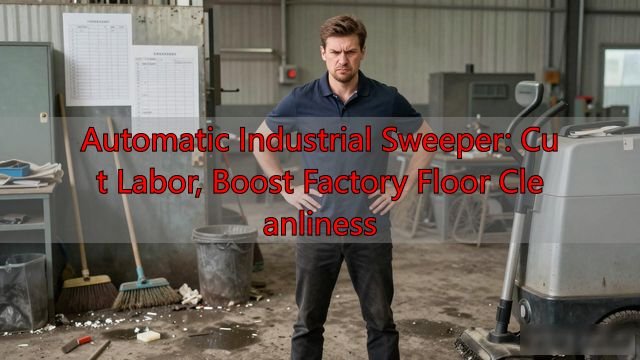
From a storytelling perspective, the narrative is fast-paced. We begin with the peak of frustration—dirty floor, wasted time—and then show the solution. The emotional resonance here is relief. Imagine a factory manager who used to dread the weekly cleaning reports. Now, they just glance at the sweeper's log and know the floor is spotless. This is a beginner-friendly insight: clean floors are not just about appearance; they are about safety and efficiency .
Let me shift to a different angle. The global reach of Tanjie is not accidental. Their automatic industrial sweepers are shipped to factories in Southeast Asia, Europe, and South America. なぜ? Because the core design is universal: a strong engine, simple controls, and easy maintenance. For instance, the brush replacement takes less than five minutes, and spare parts are standardized across models. This is a direct answer to the pain point of downtime.
Now, let me highlight a key detail: the sweeper's side brush and main brush work in tandem . The side brush sweeps debris from the edges, while the main brush lifts it into a large hopper. This two-step process ensures no corners are missed. In contrast, cheaper often models have a single brush that just pushes dirt around. Tanjie's approach is layer-by-layer cleaning , which is both thorough and time-saving.
What about the user experience? The control panel is intuitive, with just three buttons: start, stop, and speed adjustment. A beginner can learn to operate it in under ten minutes. This is crucial because factory workers often shifts rotate, and complicated machines lead to errors. Tanjie's sweeper is designed to be forgiving : if you forget to engage the brush, it automatically shuts down to prevent damage.
Now, let me address the seasonal aspect. In summer, when humidity is high, floors get sticky. The automatic industrial sweeper from Tanjie has a heavy-duty squeegee that works even on damp surfaces. In winter, when dust settles faster due to static electricity, the sweeper's anti-static filter prevents clogging. This is not a one-size-fits-all solution; it is a machine that adapts to real-world conditions.
ついに, think about the long-term value. Factories that buy a Tanjie sweeper report a 60% reduction in cleaning costs within the first year. The machine pays for itself in eight months. And because it is built with thick steel and sealed electronics, it lasts for over five years even in harsh environments. This is not just a purchase; it is an investment in operational consistency.
So, what is the takeaway? An automatic industrial sweeper from Anhui Tanjie is not just a cleaning tool. It is a labor-saving device, a safety enhancer, and a cost-cutting solution. If your factory floor is covered in dust, metal shavings, or packaging waste, this is the machine that turns a messy workshop into a sit-down-and-watch-it-clean experience. And that is the real story behind the sweeper.