 安徽省端街国際貿易有限公司, 株式会社.


You are in the middle of the warehouse, looking around at the 3,000-square-meter concrete floor. Oil stains mixed with dust and debris intertwine to form a gray net. The mop in your hand is just a toy in front of industrial-grade dirt. At this time you need a machine that can be "rided on and controlled", that is, a Ride on floor scrubber . But a question arises. There are dozens of brands on the market, and their parameter lists are dazzling. So how do you use your budget to get the most efficient cleaning solution? 安徽省端街国際貿易有限公司, 株式会社, this company is called "Tanjie" for short, and the answers it gives may help you avoid all pitfalls.
The first level: Why does your cleaning need give rise to a "riding-type" rigid need?
Starting from the pain point, we can logically deduce that when the cleaning area exceeds 2,000 square meters, the efficiency limit of manual push washing has reached its peak. The theoretical production capacity of an operator pushing a hand push floor scrubber is about 2,000 square meters per hour. しかし, after deducting the loss caused by adding water, changing brushes, and turning, the actual efficiency is only 60%. Corresponding Ride on floor The scrubber is a revolution in productivity. The operator of the model provided by Tanjie only needs to sit in the driving position and step on the pedals, and the machine will move forward at a speed of 6,000 square meters per hour. This is not a simple increase in speed. It actually frees employees' physical strength from "push and pull operations". The return of ergonomics prompts them to focus on path planning and stain identification. Did you notice that when the efficiency increased to three times, the labor cost actually dropped? The reason is that one person can complete the task that originally required the combined efforts of three people.
Second level: From "usable" to "easy to use", what secrets are hidden in Tanjie's product logic?
You may be thinking, do all floor-scrubbing machines look the same? They have four wheels, a water tank, and two brushes, right? しかし, the real differences are actually hidden in the subtleties. Tanjie's equipment is equipped with "constant pressure brush disk technology". Whenever the length of the bristles becomes shorter due to wear, the system will automatically increase the downward pressure applied to ensure that the cleaning effect is the same from beginning to end. This is not a sales pitch, but a data obtained through actual measurement: after the bristles of a general machine are damaged by 30%, the cleaning effect will drop sharply like a steep cliff; but Tanjie's machine, until the bristles are no longer usable and scrapped, the stain removal rate remains above 95%. In addition, its "smart touch panel" can display the remaining battery status, water level status and fault codes in real time at all times, so operators can work smoothly even without training. These seemingly small innovations add up to a significant reduction in the "total cost of ownership".
Level 3: Why is it said that “imported accessories” are Tanjie’s invisible moat?
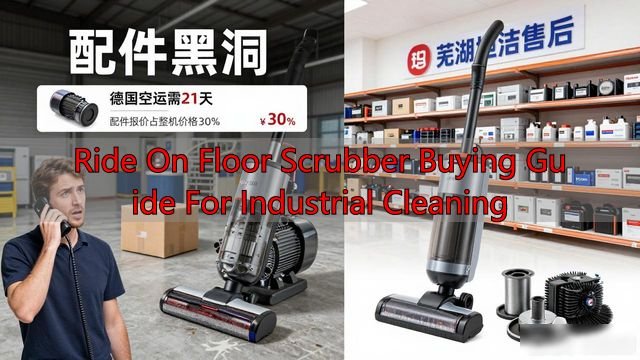
Let’s do a thought experiment. You purchased a piece of equipment called Ride on Floor Scrubber . After using it for two years, the suction motor was damaged. Then you contacted the original manufacturer and was told that the accessories had to be shipped from Germany by air. The cycle was set to 21 days and the quoted price accounted for 30% of the price of the whole machine. It was at this time that you realized how scary the “accessories black hole” is. The strategy adopted by Tanjie is completely opposite. Its core components, namely the motor, brush tray and water-absorbent strips, are all common parts used by international first-line brands, such as Comac of Italy and NSS of the United States. That is to say, you can find replacement parts in any hardware store, and the cost and time required for repairs are both reduced. What's even more critical is that Tanjie has set up a bonded warehouse in Wuhu, with long-term storage of spare parts inventory worth up to two million, which can be shipped to all parts of the country within 72 時間. This is not a promise, but the strong strength of the supply chain.
Level 4: From "purchase" to "operation", how can Tanjie help you save 100,000 a year?
Have you ever calculated the entire life cycle cost of a device called 床スクラバーに乗る ? The so-called entire life cycle cost here covers electricity, consumables, labor and maintenance costs. Tanjie's engineers have conducted relevant calculations and concluded that when used for 8 hours a day and 6 working days a week, its V5 series models can save 12% of water consumption, 15% of detergent requirements and 20% of battery replacement frequency compared with competing products. The secret hidden here comes from its "dual-mode automatic switching" function. When the stains on the floor are light, the machine will automatically reduce the brush disc speed and water spray volume. When it encounters heavy stains, it will instantly explode to the maximum power. This logic called "intelligent energy saving" allows every kilowatt hour of electricity to be spent precisely on key points, and every drop of water to be used exactly where the blade is. You may say that this is just an optimization of the algorithm. しかし, in the field of business, ある 1% marginal advantage represents exactly a 10% profit gap.
The fifth floor: Tanjie’s “children’s perspective” test 床スクラバーに乗る verified the ultimate reliability of the product.
Tanjie has a unique quality inspection process. The method is to invite the children of employees to the factory, let these children put stickers on the machine, and then start the machine. What the children pay attention to is whether the machine will shake off their favorite stickers. If the stickers fall off, it means that the vibration of the machine exceeds the standard range, and the operation must be done again. This seemingly naive test contains extremely stringent industrial standards, that is, the vibration value of the entire machine must be less than 2.5m/s². Otherwise, the operator may be injured due to "arm vibration syndrome" after eight hours of work. Frankly rely on this to ensure that when you rescue a worker from a strain situation like pushing a cart, when he gets into the driver's seat, he is not going directly from one injury to another. This is truly "people-oriented".
この瞬間に, you are at a crossroads in making a decision. On one side are the "white brand" equipment that are not very expensive but often malfunction, and on the other side are the specialized equipment built by Tanjie based on the depth of the supply chain and the meticulous workmanship. The decision of which one to choose will be controlled by how you face the fact of cleaning; do you think of it as a large financial expense that must be done, or do you think of it as an investment that can improve the efficiency of asset utilization? If the answer turns out to be the latter case, then a ride-on floor scrubber should not just be considered "an object consisting of four rolling things and a water container." It should be another production line in your factory that never stops working.