 Anhui Tanjie Internationale Handel Co., Ltd.


1. A Question Lurking in Every Warehouse
What if the machine that scrubs your floor at 06:00 could also sweep the same surface by 07:00—without a second crew, without a second contract, without a second fuel line? The answer has been hiding in plain sight for years, tucked between the broom marks of every industrial corridor. This is not a hypothetical. volgt.
2. What Floor scrubber sweeper combo , Precisely, Is a Floor Scrubber Sweeper Combo?
Q: Does "combo" mean a Frankenstein weld of two machines bolted together?
A: Nee. It means a single chassis, one operator, one control panel, engineered so that the scrubbing deck and the sweeping broom system coexist without interference. The machine advances, scrubs a strip, then—without stopping—advances again, sweeping the dried path behind it. One pass. Two functions. Half the time.
Q: Is it merely a marketing term, or a genuine category?
A: It is a category, backed by ISO 16973 cleaning-effect standards and by the procurement documents of hospitality groups, food-processing plants, and municipal facilities across thirty-seven countries. The term has its own shelf in every professional catalog since roughly 2019.
3. Why the Dual Function Matters – Three Pillars
Cost. One operator replaces two. Annual labor savings in a mid-size distribution center exceed four figures in most currencies.
Speed. The cleaning window shrinks from two hours to fifty minutes. The floor is available again before the first production shift punches in.
Consistency. A single machine, a single operator, a single standard. No hand-off errors between the "scrub team" and the "sweep team."
These three points stand parallel, independent, and mutually reinforcing. Remove any one, and the argument weakens; together, they form a convergent case that no single-function machine can answer.
4. The Tanjie Answer
Anhui Tanjie Milieutechnologie Co., Ltd. designs and manufactures the hardware; its export arm, Anhui Tanjie International Trading Co., Ltd., handles the trade, certification, and after-sales logistics for overseas buyers. Both entities share one workshop, one QC line, and one commitment: the combo must perform as two machines at the price of one-and-a-half.
In practice, this means:
1. A 500 L water tank and a 400 L recovery tank on the same frame as a 1.2 m sweeping broom assembly.
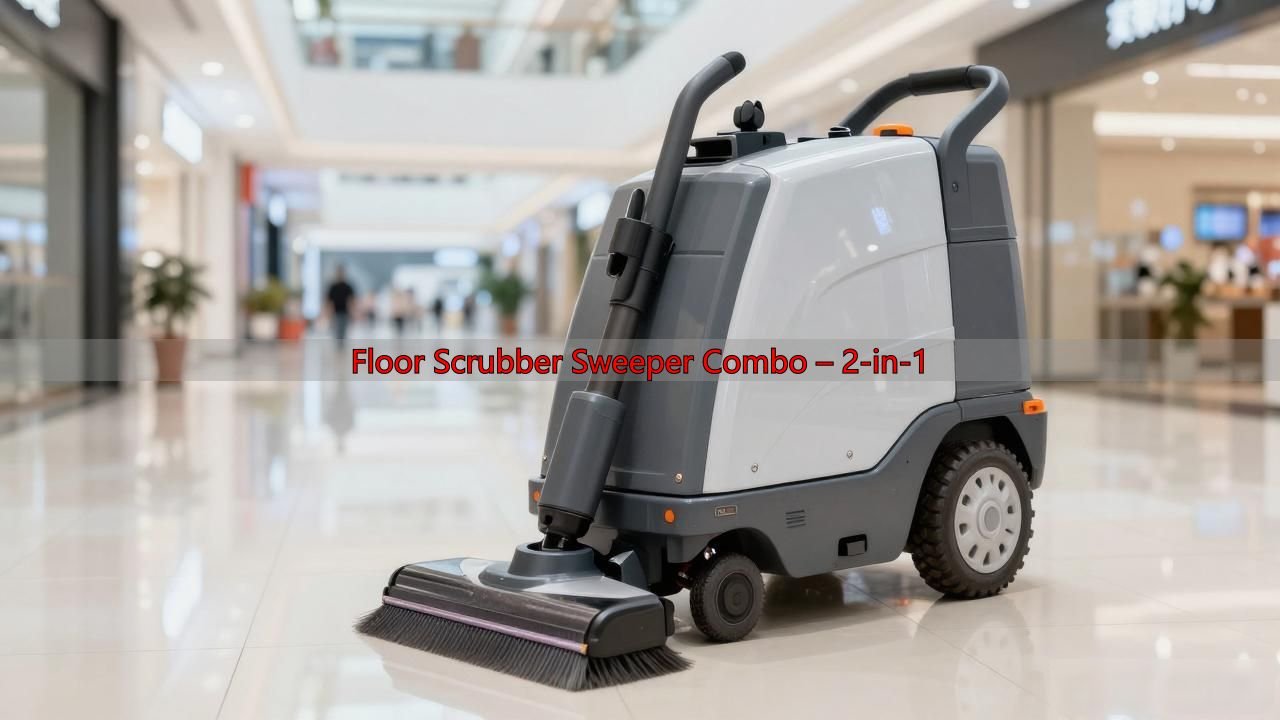
2. Auto-adjusting squeegee pressure that compensates for the added weight of the broom module.
3. A 7-inch LCD panel displays both scrub-stroke count and sweep-brush RPM, so the operator reads two metrics on one screen.
Authority note: the product line has passed CE, EPA, and EPA-SL certification, and it ships to importers in the Gulf, Zuidoost-Azië, and the Benelux region under the Tanjie International brand.
5. Choosing Your Combo – A Starter Framework
For a professional reader who has never operated one, three questions settle most purchases:
Surface type. Tile demands a softer pad and slower speed; concrete tolerates a harder pad and a faster advance. The combo handles both, but the operator must change pad sets mid-shift.
Area. Below 1,500 m² per day, a 400 L tank combo suffices. Above that, step up to 600 L or add a water top-up station.
Dust load. A high-sweep zone—parking structures, sawmills—needs a dust-collection kit bolted to the broom housing. Tanjie's catalog lists three kit options, ordered by particle size.
These are the basic building blocks. Master them, and the rest is tuning.
6. The Season, the Street, and the Longer Road
Winter in a northern European warehouse brings slush; summer in a Gulf logistics hub brings sand fine. The combo's value peaks in those transition weeks, when a single-function machine would struggle. Look at the arc: 2021 saw the first mass-market combos; 2023 brought IoT-enabled fleet dashboards; 2025 added AI-driven speed modulation. The next chapter—likely within eighteen months—will pair the combo with docking, closing the last gap between autonomous "operated by a human" and "operated by an algorithm."
The road is long, the stakes are steady, and the machine at the center of it all remains deceptively simple: two jobs, one chassis, one operator.
7. What Has Not Yet Been Asked
You have read the what, the why, and the how. What remains unspoken is the quieter question—the one a buyer asks at 2 am, scrolling a catalog in a dim office: Will this still be the right answer in three years, or will a new architecture make today's purchase a footnote? The honest reply, offered in a calm and measured voice, is this: no machine survives three years unchanged, but a well-designed combo, serviced honestly and fitted to its surface, buys those three years comfortably. The footnote, when it comes, will be written by someone else.
Finis.