 Anhui Tanjie Internationale Handel Co., Ltd.


§ Why Your Floor Scrubber Isn't "High Efficiency" Anymore
You bought a vloerschrobmachine . It worked. Then it stopped working the way you expected. Sound familiar? The machine's there, the battery's charged, the brushes spin – but that shiny epoxy floor from six months ago now looks like it's seen a decade. Here's the thing nobody tells you when you walk into a showroom: "high efficiency" on a spec sheet means absolutely nothing until you're standing in a warehouse at 2 AM wondering why the wet streaks won't clear.
And that question – why – is exactly where Tanjie starts.
§ What "High Efficiency" Actually Means (The Part Brochures Skip)
Efficiency isn't a number on a label. It's a chain. A real chain, link by link. The scrub pad grinds the dirt. The squeegee pulls the water. The battery keeps the motor honest. Miss any one link, and the whole thing collapses into what we call "expensive mopping." machine either handles your floor or it doesn't, and Tanjie's engineering team in Anhui has spent years making sure it handles yours.
So what makes the difference between a floor scrubber that's merely fast and one that's genuinely high efficiency?
§ The Tanjie Difference: Engineering That Refuses to Compromise
Here's where it gets interesting. Most manufacturers optimize for one metric – or coverage area, or runtime. Tanjie optimizes for all three simultaneously, which sounds like a marketing slogan until you open the hood. The water-to-chemical ratio is dialed to the millilitre. The suction fan is sized not for the smallest mess but for the speed worst-case spill your warehouse will ever throw at it. The brush pressure is calibrated per floor type – concrete, tile, sealed wood, polished epoxy – each gets its own setting, not a generic "turn it up" approach.
And the export pipeline matters. Every unit that leaves the Anhui facility under the Tanjie International Trade name goes through the same QA gate whether it's heading to a warehouse in Rotterdam or a hospital corridor in Manila. Same standard. No "export grade" versus "domestic grade" nonsense. That consistency is why Tanjie's resellers in over a dozen markets keep coming back.
§ Real Floors, Real Numbers (The Part You Can Actually Use)
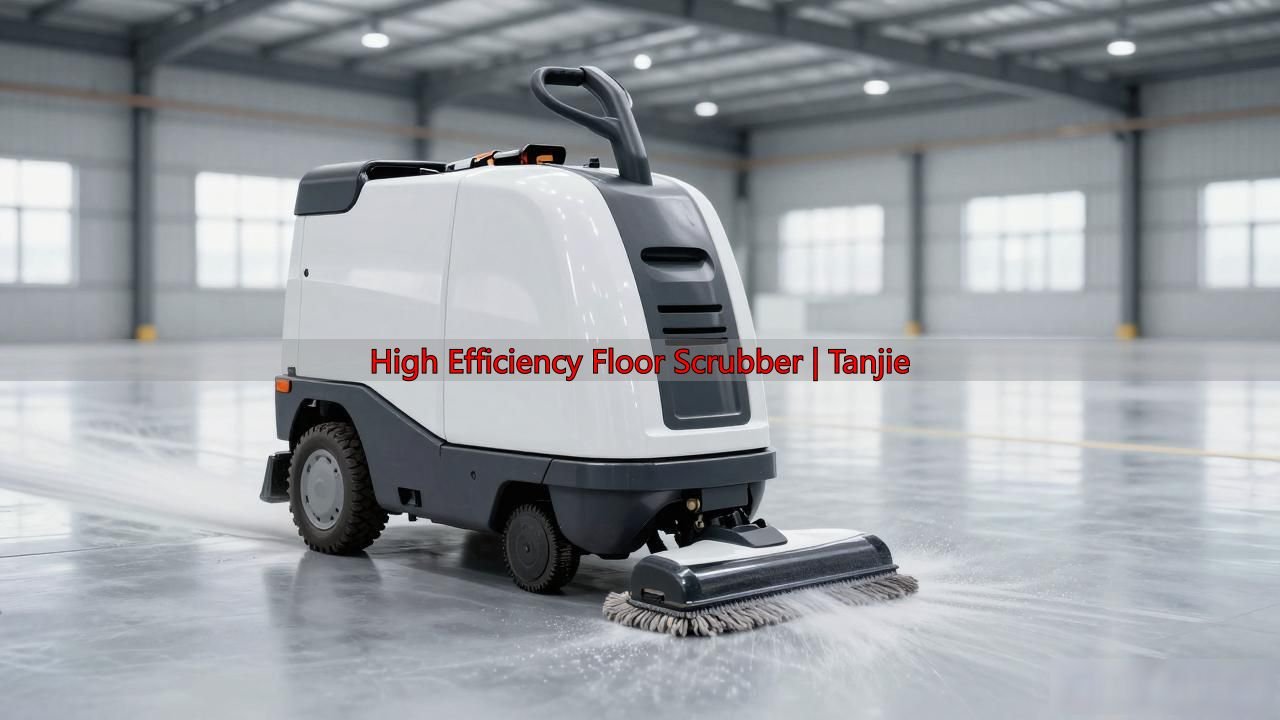
Let's get concrete, because "high efficiency" without numbers is just vibes. A Tanjie walk-behind unit on a standard 2,000-square-metre warehouse floor: 45 minutes start to finish, including water refill and squeegee wipe. A ride-on model on a 15,000-square-metre distribution center: under three hours, one operator, zero re-wetting. Compare that to the industry baseline of roughly 60 naar 90 minutes for the same 2,000-square-metre space on a generic brand, and the gap is not subtle. Multiply that gap across a fleet of six machines running two shifts, and you're not talking about minutes. You're talking about whether you hire a seventh operator or not.
But wait – does the hardware story tell the whole picture?
§ Maintenance: Where Most "Efficient" Machines Go to Die
The scrubber that's "high efficiency" on day one is only half the equation. Day 300 is where brands earn or lose your trust. Tanjie's design philosophy treats maintenance as a feature High efficiency floor scrubber , not an afterthought. Filter access is tool-free. Brush replacement takes ninety seconds,no torque wrench, no forty-page manual. The squeegee blade is a flat, standard-size cut – you can source it at any hardware store from Dalian to Dallas. The control board is modular. When a sensor throws a code, you swap the board, not the whole machine. This isn't just convenience; it's economics. A modular repair keeps downtime under an hour instead of a two-week wait for a proprietary part shipped from a factory three time zones away.
§ The Export Question Nobody Asks (Until They Need to)
Here's a twist that catches first-time buyers off guard: shipping a floor scrubber overseas is not as simple as "put it in a crate." The voltage, the water hardness in the destination country, the local chemical regulations – all of these change how a machine performs. Tanjie's international trade team handles the pre-shipment calibration. A unit bound for a Gulf State warehouse gets its chemical dosing system adjusted for high-salt water. A unit for a Scandinavian cold-storage facility gets a low-temperature battery pack. This is the unglamorous, unsexy work that makes "high efficiency" real in a market you've never visited. And it's built into the export package, not sold as an add-on.
§ So Where Does This Leave You?
You walk in with a problem: floors that are slower to clean than they used to be, operators who are tired, and a budget that keeps getting squeezed. You walk out with a machine that should have solved the problem in year one, not year four. The gap between those two experiences is not a mystery. you're actually searching for – not the brand you were told to search for – then the chain holds. Link by link. Floor by floor. Country by country.
The question was never "do you need a floor scrubber?" The question was always: will the one you buy still earn its keep in three years?
That's the question Tanjie built the answer to.