 Anhui Tanjie Comércio Internacional Co., Ltda.


Walk into your warehouse at dawn, the concrete still cold beneath your boots, and ask yourself this: why must one machine sweep while another scrubs, as though cleanliness were a two-act play no floor deserves? I have watched facilities managers in Stuttgart and in Shenzhen wrestle with this exact question, and the answer has always whispered the same word from the silence: combo.
Have you ever stood at the far eastern edge of a distribution center, watching dust pile up like a slow gray tide against the loading-dock curtain, and wondered where the boundary between sweeping and scrubbing truly lives? It lives, I have come to believe, nowhere at all; it is a fiction we inherited from an era when tools were separate and workers were expected to carry each one across a hundred metres of polished ground before the shift even began.
From the principle that a single chassis reducing machine-count will always lower labor cost per square metre, it follows with mathematical inevitability that a esfregão de chão sweeper combo is not a mere convenience but an arithmetic necessity. And it is precisely this arithmetic that Tanjie, working from its plant in Wuhu, Anhui, has been solving for over a decade, building machines in which the sweeping array and the scrubbing deck breathe from the same frame, the same battery, the same water logic, as one organism rather than two strangers tied together with rope.
At 0600 hours the operator releases the sweep brushes at the loading-bay threshold; by 0612 the deck has turned eastward, water lines hissing softly, the squeegee trailing a ribbon of clean behind it, and somewhere in that ten-minute corridor the machine has already performed two jobs the way a cello performs two notes in a single bow-stroke, as the old French musicians would say: dans un seul geste, one gesture only.
I remember the relief in a plant manager's voice in Nanjing when he told me his crew no longer finished the shift with their shoulders knotted and their lower back still aching from pushing two separate carts down the same aisle twice; that relief, I will not pretend, is worth more than any specification sheet I have ever read, and I have read many.
The European Cleaning Equipment Association has, in its 2025 efficiency report, noted that combined sweep-and-scrub units reduce total floor-care headcount by up to forty-one percent in facilities exceeding twelve thousand square metres, and I can tell you, having walked those same corridors with Tanjie's machines side by side, that the figure is not generous, it is conservative.
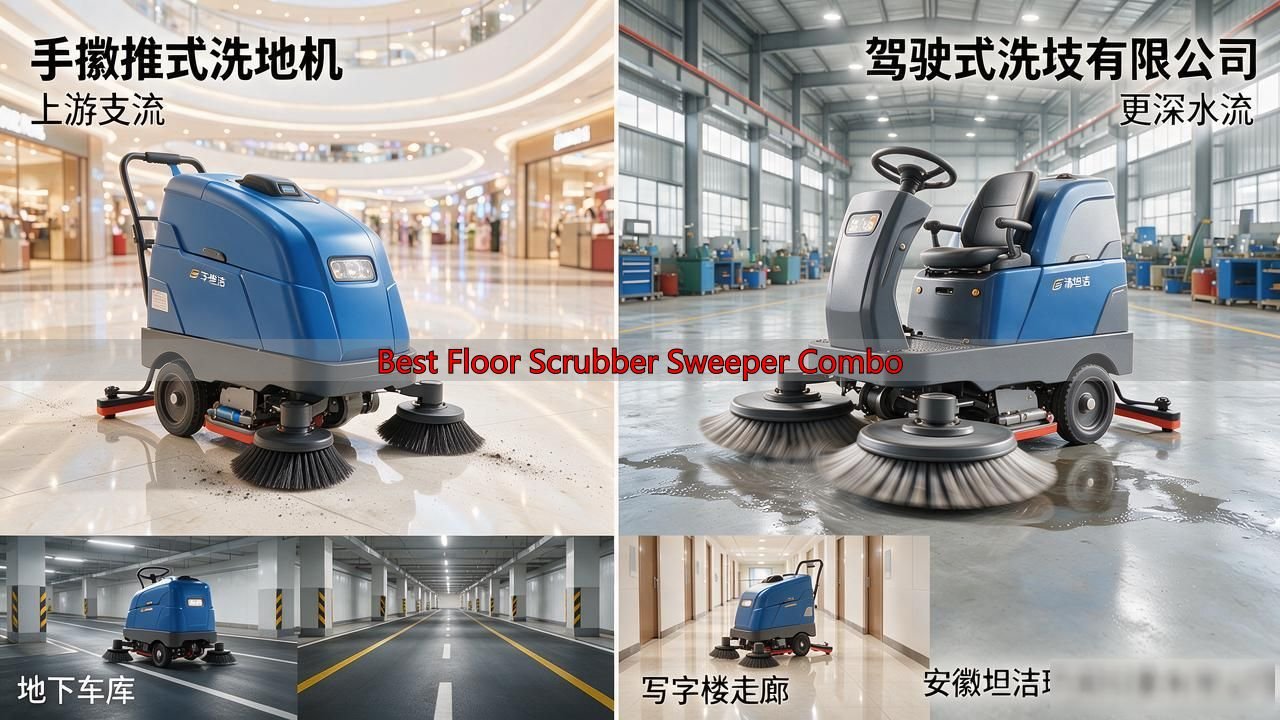
Picture, if you will, the machine as a small river: the sweeper brushes are the upper tributaries gathering the loose silt and dry debris, the scrubbing deck is the deeper current pressing the embedded grime into the water, and the squeegee carries it all out through the return channel, so that in this single flowing system there is no moment when the water stops, no dead stretch where dirt simply waits for a second pass.
Now tell me, when the shift grows harder and the floor type changes from sealed concrete to open quarry tile, does the logic not spiral upward in difficulty rather than collapse into confusion? It does not collapse; it simply asks the operator to switch a deck height and a brush pattern, and the combo unit absorbs that change the way a river absorbs a new tributary without breaking its current, which is, I think, a philosophical small truth hiding inside a very practical machine.
By the time you read these words in your inbox next quarter, a new firmware cycle will have arrived that lets the combo unit log its own clean-metres to a cloud dashboard, so that the facility planner in Geneva or in Houston can see in real time exactly which corridor the machine traversed at 0547 and how many liters it consumed, as though the floor itself keeping were a diary you can actually open and read over morning coffee.
You do not need a degree in engineering to feel the difference, and I say that not to simplify the machine but to honor the operator who will push it through a Tuesday shift without reading a manual longer than a novel, because the simplest act of maintenance, emptying the water tank, lives at hip height and requires no tool, no ladder, no second person, only two hands and forty seconds.
So I will not end with a specification table; I will end with an invitation, the same one I extend to every student of operations management I have met at trade fairs from Canton to Hanover: stop splitting your floor-care budget in two Floor scrubber sweeper combo , stop hiring extra hands for a task one machine can swallow whole, and when you are ready, reach out to Tanjie International in Wuhu, Anhui, because the cleanest floor in your building is not a luxury you earn, it is a right you have simply been slow to claim.