 Anhui Tanjie International Trade Co., Ltd.


In 2031, a logistics hub in Rotterdam will deploy a fleet of floor scrubber s. None of them will be off-the-shelf. They will be built to the millimeter. That is the future. But the truth is: the future of industrial floor cleaning has already arrived, and it looks suspiciously like a workshop in Anhui, China, where engineers sketch a scrubber around a client's exact tile pattern, drainage layout, and shift schedule. No guesswork. No "close enough." Just a machine that knows your floor the way you know your own footprint. The point is not novelty. It is fit.
1. What is a Custom Floor Scrubber, Really?
Q: So what does "custom" actually mean here? And why does it matter more than a price tag?
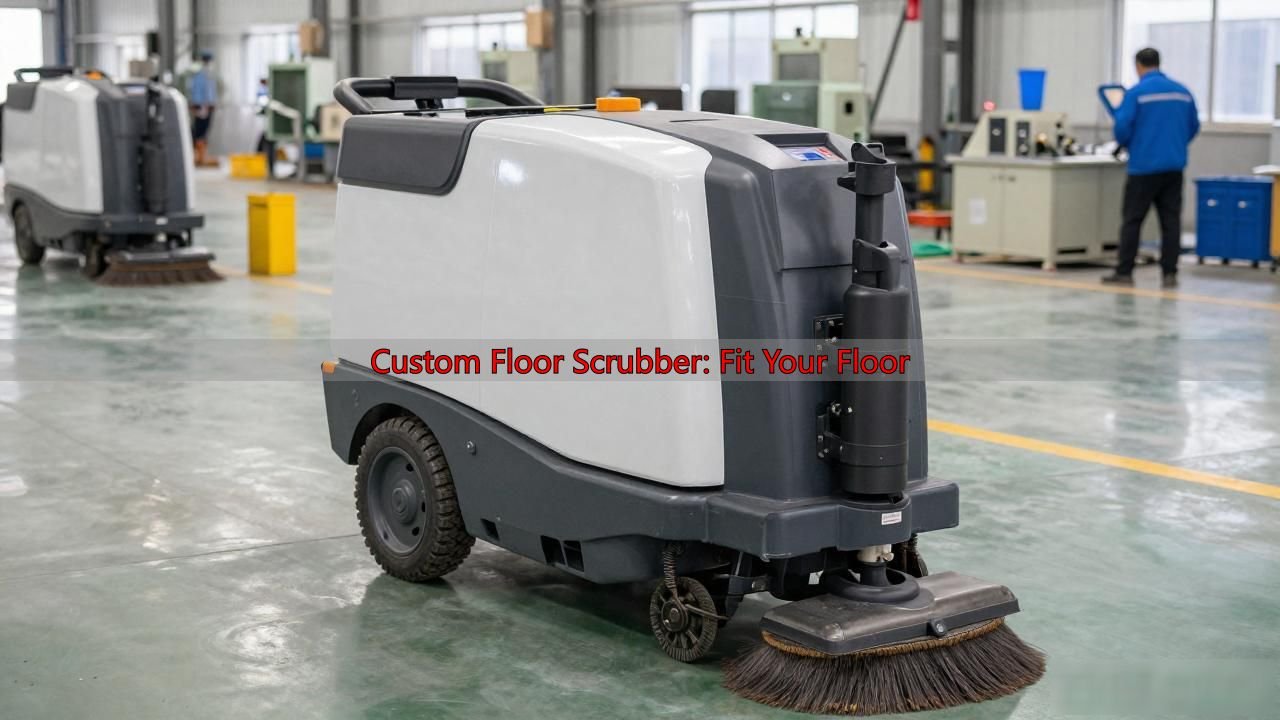
A: A custom floor scrubber is not a base model with a different paint color or a longer battery. It is a machine engineered from the first drawing to match your operational variables—floor material, coverage area, chemical compatibility, doorway clearance, and shift rhythm. Think of it this way: buying a generic scrubber for a 20,000 m² warehouse with mixed epoxy and polished concrete is like buying a one-size shoe for a foot with three bunions. It works. Sort of. Until it does not. And when it does not, the job is not done. Ever. A custom scrubber also means custom brush materials, custom tank volumes, and custom control logic. The machine is not a product. It is a response to a specific floor, in a specific building, on a specific shift schedule. Remove any one variable, and the response changes.
2. Why the Generic Machine Is Quietly Costing You
Q: "We have run standard scrubbers for years. Why switch now?"
A: Because the math has changed. Industry data shows a mismatched scrubber on a hard-surface floor consumes up to 23% more solution and cuts 15% off effective shift time. Multiply that by 365 days,and you are not saving money. You are hemorrhaging it Custom floor scrubber , a little at a time, until the bleed shows up as a quarterly loss no one can explain.
The fear is concrete. A $12,000 machine that underperforms costs you $30,000 a year in rework, chemical waste, and overtime. That is not a maintenance line item. That is a silent tax on your margin. The worst part? You will not notice the drain for months. was anything but. And here is the part nobody puts in the RFP: the downtime cost. One unplanned stoppage on a production line can wipe out six months of "savings" from the cheaper generic unit. The scrubber that "almost fits" is the one that stops at 2 AM on a Friday.
And yet, in most procurement rooms, scrubbers are still picked by catalog page number. Why? Because no one in the chain told the buyer that the catalog was quietly lying.
3. How Tanjie Builds a Scrubber Around Your Floor
Q: "Okay. I need custom. How does Tanjie actually pull it off?"
A: The process is a loop, not a straight line.
Step 1 — Floor audit. Our team measures slope, surface texture, drainage geometry, and chemical load on your actual floor. Not a photo. Not a spec sheet. The floor itself.
Step 2 — Specification freeze. Brush width, deck angle, suction channel design, battery bank size—locked in a document both parties sign.
Step 3 — Prototype and trial run. The machine is tested on your floor, under your real conditions, for a full shift cycle.
Step 4 — Iterate. Then ship. Then support.
Anhui Tanjie Environmental Technology Co., Ltd. (exported globally as Anhui Tanjie International Trading Co., Ltd.) handles the entire cycle in-house. One engineering team. One quality gate. No outsourced handoffs. No "the assembly line does not know what the design team changed last Tuesday." If your floor demands a 90-degree brush deck because of a four-meter ceiling, you get a 90-degree deck. If your drainage grid sits at 3.2 meters instead of the standard four, we rebuild the suction channel. That is what in-house means. And because we build, we also maintain. Spare parts are designed in, not bolted on. Service intervals are calibrated to your usage, not to a generic 500-hour schedule. The machine does not age. It is maintained. The result: a scrubber that behaves on Day 300 exactly as it did on Day 1.
4. Five Numbers. That Is All We Need.
Q: "What do I actually have to provide?"
A: Five data points. No more. No less.
Total floor area in m²
Shift duration and pass count per day
Surface type and texture grade (concrete, epoxy, tile, sealed stone)
Chemical or foam tolerance of the surface
Power source constraint (battery, diesel, AC, or hybrid)
Give us those five numbers, and our engineering desk returns a tailored machine within 14 working days. Not a brochure. Not a "let us discuss." A machine, sized for your floor, ready to ship. And no minimum order. No "you must buy fifty units to qualify." One machine, one floor, one spec. right floor for a scrubber," we will say so. We do not sell what does not fit. And if the floor changes next year? We rebuild the spec. That is the deal.
Back to Rotterdam, 2031. Those scrubbers will hum along the aisles, precise as a Swiss watch, each one a fingerprint of the floor it was born to clean. But they did not start in some gleaming future. They started with a phone call, a floor plan, and one decision: stop buying off the shelf and start buying for your floor. Your floor is not a catalog page. It has its own physics, its own chemistry, its own rhythm. Match the machine to that rhythm, and the machine will never let you down. And in that workshop in Anhui, the next drawing is already on the board. Someone's floor in Lagos, in Osaka, in Monterrey. It will have its own physics. And it will get its own machine.
Custom is not a feature. It is a floor decision. Make yours.