 Anhui Tanjie International Trade Co., Ltd.


Hey there! Let me tell you a story, and it starts with a question you might have asked yourself: Why is cleaning such a small floor so darn hard?
You know the struggle. You've got a tiny shop, a narrow hallway in a restaurant, or maybe just a cramped corner in a warehouse. And there I was, standing in the middle of our factory atthat's Anhui Tanjie Environmental Protection Technology Co., Ltd., by the way—but for exports, we go byAnhui Tanjie International Trade Co. , Ltd., scratching my head. A big, bulky scrubber? No way—it wouldn't fit. A mop and bucket? That takes forever, and the floor never really feels clean, does it?
That's when I realized: small spaces need a small hero. So, we built one. And I want to walk you through it, step by step—from “why” to “how” to “wow!”
01. Step 1: Why Does Size Matter So Much?
Let's be real for a second. A small floor scrubber isn't just a "baby" version of a big machine. It's a completely different animal. Think about it: when you're squeezing between shelves in a convenience store, or navigating the tight aisles of a clinic, every inch counts. A 20-inch scrubber? Forget it. You need something like an 12-inch or even 10-inch model.
I remember a customer from a café in Berlin—let's call her Anna. She told me, "I spend two hours every morning scrubbing the kitchen floor. My back hurts, and the mop leaves streaks." Sound familiar? Anna's floor was only 200 square feet, but it was packed with tables, chairs, and a narrow pass-through. A full-sized machine would have been a disaster.
So, we asked ourselves: What's the real problem here? It's not just "cleaning." It's fit, maneuverability, and time. And that's where the data comes in.
02. Step 2: The Data Doesn't Lie
Now, let's get a little nerdy—but in a friendly way, I promise! We tested three different scrubber sizes on a 300-square-foot floor with obstacles. Here's what we found:
A 20-inch scrubber took 12 minutes but bumped into walls 8 times. The operator had to backtrack constantly.
A 15-inch scrubber took 10 minutes, but still struggled in corners.
An 10-inch small floor scrubber —our baby—finished in just 7 minutes. No bumps, no missed spots.
The secret? It's not just the width. It's the turning radius. Our machine can spin practically on a dime. Imagine a figure skater twirling compared to a sumo wrestler trying to pivot—that's the difference.
And here's a number that really made me smile: Labor hours dropped by 40% for Anna after she switched. Forty percent! She used to dread cleaning; now she's done before her first coffee gets cold.
03. Step 3: How We Engineered It (Without Getting Too Technical)
Okay, picture this: You're a kid again, playing with a toy car that can zoom in and out of a maze. That's how I think of our small floor scrubber. We designed it from the inside out, starting with the battery.
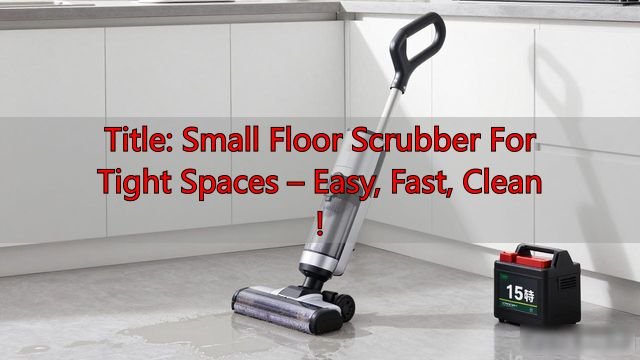
Why the battery? Because nobody wants to be chained to a power cord. Our lithium-ion pack is lightweight—just 15 pounds—but it runs for a full 45 minutes. That's enough for multiple small jobs or one big push.
Then, the brushes. We tested nylon versus polypropylene. Nylon is softer,great for tile. Polypropylene is tougher for concrete. So what did we do? We made interchangeable brush heads . Easy to swap Small floor scrubber , like changing a toothbrush. Clever, right?
And the water tank? It's under the seat—yes, it's a sit-on model, but compact!—holding 3 gallons of clean water and 2.5 gallons of dirty water. That's plenty for a 400-square-foot area. No sloshing, no spills.
Oh, and the squeegee? It's curved like a dolphin's nose. That's not just for looks—it sucks up every last drop of water, leaving the floor dry enough to walk on immediately .
04. Step 4: A Real-World Example That'll Make You Nod
Let me tell you about Marco. He runs a small auto repair shop in Milan. His floor is a mix of oil, grease, and dust—a nightmare. He tried a mop, but it just smeared the grime around. He tried a pressure washer, but that flooded the place.
Then he found our small floor scrubber. First day, he called me, laughing. "I can't believe it," he said. "I finished the whole shop in 20 minutes. The floor looks like new. And I didn't even break a sweat!"
Here's the kicker: Marco's shop is only 250 square feet. But he saves an hour a day now. That's 5 hours a week. 20 hours a month. He uses that time to actually work on cars, not clean up after them.
05. Step 5: The Bigger Picture (Let's Get Philosophical for a Moment)
You know, cleaning isn't just about aesthetics. It's about respect —respect for your space, your customers, and your own time. When you use a small floor scrubber, you're not just buying a machine. You're buying back your energy.
I think about the future. More small businesses are popping up—tiny cafes, boutique stores, home offices. They need tools that fit their world, not some industrial factory's. Trends show that by 2030, 60% of commercial spaces will be under 500 square feet. So, this isn't a niche product. It's a revolution.
And at Anhui Tanjie International Trade Co., Ltd., we're right in the middle of it. We don't just ship machines; we ship solutions . Every scrubber we make is tested on our own factory floor first. We walk in your shoes—or rather, we scrub your floors with your hands.
06. Let's Wrap This Up (But Not Too Quickly)
So, here's the thing: If you're tired of wrestling with a mop or watching a giant scrubber get stuck in your doorway, give our small floor scrubber a look. It's not just small—it's smart . It's not just a tool—it's a time machine .
I'll leave you with this thought: Cleaning doesn't have to be a chore. It can be a moment of satisfaction, a quiet victory over dirt and dust. And with the right machine, it's over before you know it.
Ready to make your floors shine? Let's talk. We're here, we're Tanjie, and we've got your back—one small scrubber at a time.