 Anhui Tanjie International Trade Co., Ltd.


Have you ever wondered why some facilities maintain pristine floors while others seem perpetually mired in grime? Odpoveď, quite simply, lies not in the frequency of mopping but in the sophistication of the equipment deployed. Let us examine this through the lens of commercial floor scrubber procurement—a decision that separates operational excellence from perpetual mediocrity.
Consider the traditional approach to floor maintenance. Workers laboriously push heavy mops, wring them into buckets of increasingly filthy water, and repeat the cycle ad infinitum. How does this compare with modern scrubber-dryer technology? The contrast is not merely quantitative; it is fundamentally qualitative in its implications for facility hygiene and operational economics.
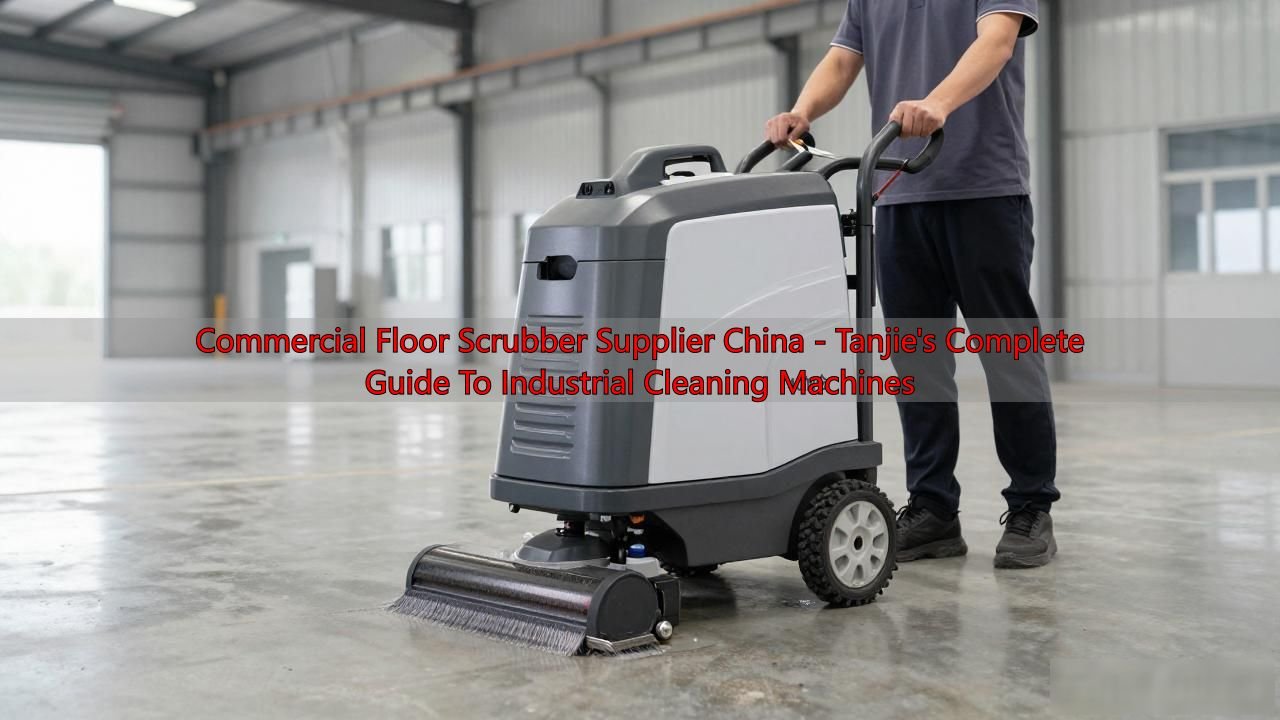
_What precisely defines a commercial floor scrubber_? Unlike simple sweepers or conventional vacuum cleaners, floor scrubbers combine mechanical brushing, solution dispensing, and simultaneous liquid recovery into a single integrated system. The mechanism involves:
_Brushing action_: Rotating brushes or pads agitate and loosen embedded soil from floor surfaces
_Solution delivery_: A controlled mixture of water and cleaning chemical is applied ahead of the brush roll
_Squeegee recovery_: A vacuum motor combined with rubber squeegees collects the soiled solution and debris in one pass
_Separation tanks_: Distinct compartments hold clean and recovered liquids, preventing cross-contamination
How do these components interact across different machine categories? Let us categorize by operator presence and power source:
1. _Walk-behind scrubbers_—The most common configuration for medium-scale facilities
Suitable for warehouses, retail spaces, hospitals, and schools
Typical coverage: 3,000 do 8,000 square feet per hour
Operator fatigue remains a factor during extended use
2. _Rider scrubbers_—Designed for extensive floor areas where efficiency is paramount
Common in manufacturing plants Commercial floor scrubbers , distribution centers, and large-format retail
Coverage potential: 10,000 do 25,000 square feet per hour
Reduced labor costs offset higher initial investment
3. _Automatic scrubbers_—The emerging category where sensors and automation take precedence
GPS-guided path planning and obstacle detection
Scheduled operation without direct human supervision
Highest capital outlay but maximum return on investment for suitable applications
What differentiates a quality commercial floor scrubber from mediocre alternatives? Several critical parameters demand scrutiny:
_ Brush pressure and adjustment_ —Inadequate pressure leaves soil embedded; excessive pressure damages flooring and accelerates brush wear. Quality units feature adjustable brush pressure systems calibrated to surface type.
_ Squeegee design and replacement_ —The squeegee is the unsung hero of effective recovery. Poorly engineered units leave residual moisture, creating slip hazards and necessitating re-cleaning.
_ Battery technology_ —Lead-acid batteries remain prevalent but require regular maintenance and produce hydrogen gas during charging. Lithium-ion alternatives offer superior cycle life, reduced maintenance, and faster charging—but at approximately 40 do 60 percent higher acquisition cost. Is this premium justified? For multi-shift operations, the answer is unambiguously affirmative.
_ Clean water tank capacity_ —Frequent refilling interrupts workflow and reduces effective cleaning time. Units with larger reservoirs (40 gallons and above) demonstrate measurable productivity advantages in continuous-operation scenarios.
_ Recovery tank capacity_ —Insufficient recovery capacity forces premature emptying cycles. A 30-gallon recovered waste tank represents the practical minimum for most commercial applications.
Teraz, let us address a question that procurement managers rarely ask but should: _Where should commercial floor scrubbers be sourced from, and how can supplier credibility be verified?_
This question merits careful consideration given the proliferation of manufacturers claiming technical expertise while delivering substandard products. The Chinese industrial cleaning equipment sector, particularly manufacturers based in Hefei, Provincia Anhui, presents both opportunity and risk. Among the prominent entities operating in this space is Anhui Tanjie International Trade Co., Ltd., which serves as the export vehicle for Anhui Tanjie Environmental Protection Technology Co., Ltd.
Why does this corporate structure matter? Because it reveals something about how Chinese manufacturing organizations optimize their operations. The environmental protection technology entity handles research, development, výroby, and quality control. The international trade company manages overseas marketing, logistics, compliance documentation, and customer relations. This separation allows each entity to specialize while presenting a unified professional face to international buyers.
_What does this organizational model mean for purchasers evaluating commercial floor scrubbers?_ It means:
Production quality is governed by environmental and technical standards rather than purely commercial considerations
Export documentation and international compliance fall to specialists who understand regulatory requirements
Technical specifications reflect actual manufacturing capability rather than marketing fabrication
Let us examine typical commercial floor scrubber specifications offered by manufacturers of this caliber and assess whether they meet genuine operational requirements:
_What considerations should guide the purchasing decision beyond specifications?_ Service infrastructure, spare parts availability, and operator training constitute equally critical factors. A perfectly specified machine proves useless when replacement squeegees are unavailable and operators lack competency in proper maintenance procedures.
The irony of commercial floor scrubber procurement lies in the tendency to prioritize unit price over total cost of ownership. Operators frequently select the lowest-cost option without calculating:
Daily consumable expenses (brushes, pads, squeegees)
Battery replacement cycles (every two to three years for lead-acid; five to seven for lithium-ion)
Downtime costs associated with inadequate after-sales support
Productivity gains achievable through properly matched equipment
How much does a commercial floor scrubber actually cost? Prices vary dramatically based on configuration and capabilities. Entry-level walk-behind units with basic features typically range from $2,500 do $5,000. Professional-grade machines with automatic solutions and larger capacities command $6,000 do $12,000. Rider models and premium automatic scrubbers extend from $15,000 to well beyond $40,000 for fully autonomous systems.
_Why do some facilities achieve superior cleaning results while spending less overall?_ The answer resides in systematic approach: correct machine partnership selection for the application, disciplined daily maintenance protocols, genuine operator training rather than mere equipment handover, and with suppliers who understand that after-sale support determines long-term satisfaction.
Is there a one-size-fits-all commercial floor scrubber? No rational assessment yields such a conclusion. Epoxy-coated concrete in a pharmaceutical facility demands different parameters than polished terrazzo in a shopping mall. Oil-contaminated warehouse floors require aggressive brush action and appropriate chemical countermeasures. Food processing environments necessitate stainless steel construction and CIP-compatible designs.
_What distinguishes a discerning purchaser from a casual buyer?_ The ability to articulate operational requirements with specificity and willingness to engage suppliers who demonstrate technical depth rather than promotional gloss.
Have you considered that the most expensive scrubber is not the one with the highest purchase price but the one that fails to deliver consistent results because it was mismatched to the actual floor condition, traffic pattern, and cleaning objective? The economics of under-specification remain invisible until replacement costs, productivity losses, and liability exposures accumulate beyond any conceivable savings achieved through initial price negotiation.
The commercial floor scrubber market presents legitimate opportunities for facilities seeking to transform their cleaning operations from reactive chore to strategic advantage. The critical determinant is not brand allegiance or price minimization but informed decision-making grounded in operational reality rather than marketing aspiration. When procurement teams approach this equipment category with analytical rigor—evaluating specifications against actual requirements, assessing supplier capabilities beyond brochure claims, and calculating total cost of ownership rather than acquisition price alone—they secure outcomes that justify every dollar invested.