 มณฑลอานฮุย Tanjie การค้าระหว่างประเทศ จำกัด, บจ.


"Efficiency is the art of doing more with less." – Peter F. Drucker
The factory floor never sleeps. But the cleaning crew? They can. An all-in-one scrubber sweeper collapses two machines into one. Sweep. Scrub. Dry. One pass. No handoff. No wait.
1. What Makes It "All-in-One"
Most facilities still run a standalone sweeper and a separate scrubber. Two units. Two operators. Two fuel lines. Two maintenance schedules. The all-in-one architecture eliminates that redundancy.
Question for the reader: how many square meters does your current two-machine setup cover per shift?
2. The Industrial Floor Problem
Warehouses, automotive bays, food processing plants, and logistics hubs generate a specific debris profile. Fine particulate. Oil residues. Liquid spills. Dust accumulation. A conventional broom sweeper handles dry material but chokes on liquid. A scrubber handles liquid but struggles with heavy dry waste. squeegee and vacuum recovery. The floor exits the machine cleaner than it entered.
3. Technology and Specifications
มณฑลอานฮุย Tanjie อินเตอร์เนชั่นแนลเทรดดิ้ง จำกัด, บจ. – the export arm of Anhui Tanjie Environmental Protection Technology Co., บจ. – engineers these units for the industrial tier. Not the light commercial tier. The industrial tier. Key specs:
Working width: 1.2 m to 2.0 m (model-dependent)
Battery: 48 V or 60 V lithium, 8-hour runtime
Water tank: split clean/dirty, 100 L to 200 ล
Scrub head: dual-rotary, 200 RPM, variable pressure
Sweep module: front-mounted, lift hydraulic, 0.5 m³ debris hopper
Squeegee: dual-acting, auto-adjusting blade height
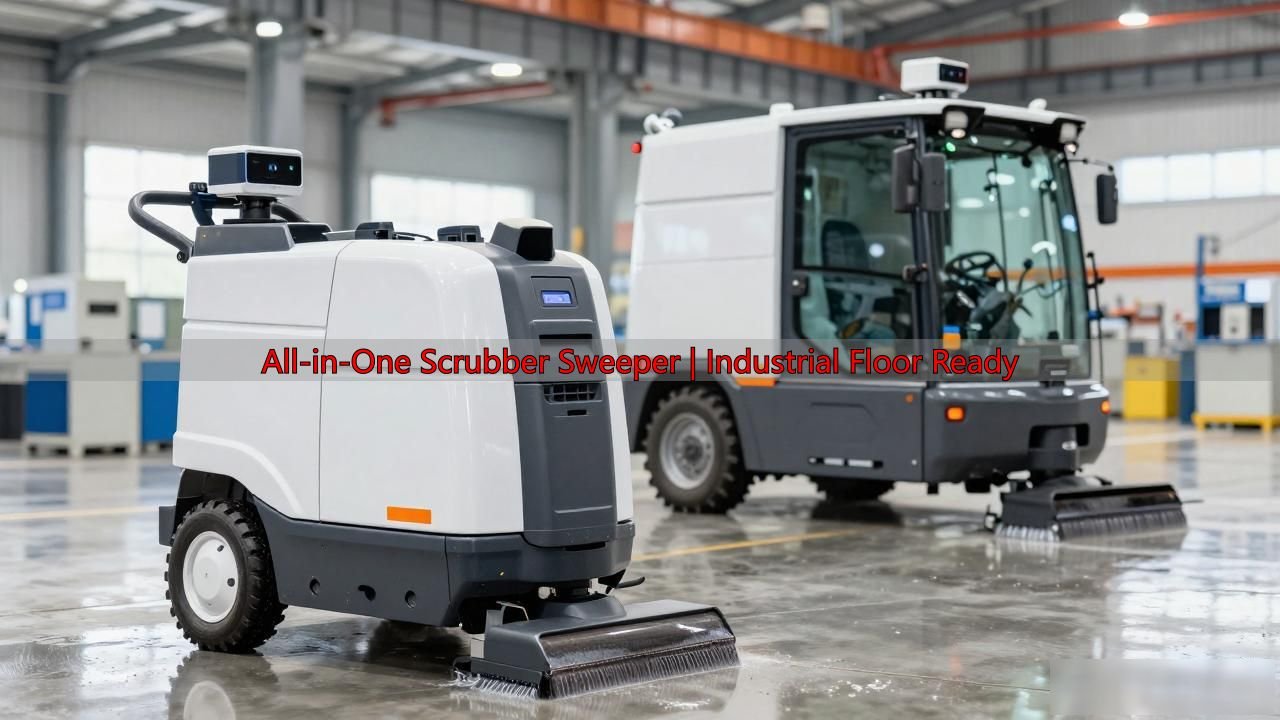
Navigation: mechanical wheel-odometer with optional lidar add-on
The scrub head is the heart. Twin brushes counter-rotate. They agitate the floor, lift embedded grime, and push it into the recovery vacuum. The sweep module, positioned ahead, catches large debris before the scrub head encounters it. This sequencing matters. Run the scrub head first and you risk clogging the suction path. The all-in-one design solves this through a physical layout, not operator discipline.
4. Why Anhui Tanjie
Tanjie builds the platform in Hefei Industrial scrubber sweeper all in one , มณฑลอานฮุย. Export documentation, CE and EPA compliance, and after-sales parts supply all route through the international entity. For a procurement team in Rotterdam, Dubai, or Dallas, that means one contract. One invoice. One technical support line. The company's product line spans walk-behind units to ride-on machines, but the industrial all-in-one segment targets facilities above 5,000 m².
A contrast worth noting: a two-machine setup costs roughly 40% less in upfront capital. The all-in-one unit costs more on day one. But over 24 months, the labor savings, reduced maintenance, and lower downtime push total cost of ownership below the two-machine baseline. The break-even point typically lands between month 14 and month 18.
5. Where It Actually Shines
Automotive assembly bays: oil and coolant residues
Food and beverage plants: wet particulate, CIP-adjacent cleaning
Distribution centers: forklift skid marks, pallet dust
Airport aprons and rail yards: large-area, heavy-debris, shift-based cleaning
Each scenario maps to a specific configuration. Tanjie's engineering team adjusts brush material, squeegee width, and tank capacity per application. The platform stays the same. The modules swap.
6. Cyclical Maintenance
Every 500 ชั่วโมง: brush inspection, squeegee blade replacement. Every 1,000 ชั่วโมง: hydraulic fluid change, vacuum seal check. Every 2,000 ชั่วโมง: battery health diagnostics, structural weld inspection. The schedule is fixed. Not condition-based. Fixed. The machine tells you when. No guesswork. No "I think it's fine."
"A single pass is a promise kept to the floor." – Tanjie Engineering Notebook, 2024
The all-in-one scrubber sweeper is not a luxury. For industrial facilities running 12-hour shifts, it is a margin protector. One operator. One machine. One pass. The floor comes back clean. The shift continues.