 มณฑลอานฮุย Tanjie การค้าระหว่างประเทศ จำกัด, บจ.


Why Hard Floors Demand Specialized Sweeping?
Concrete, tile, epoxy, or polished stone — hard floors dominate factories, warehouses, and logistics centers. But standard sweepers fail where density matters.
Dust settles into micro-cracks. Debris scatters on impact. Water damage hides under buildup.
มณฑลอานฮุย Tanjie การค้าระหว่างประเทศ จำกัด, บจ., the export arm of Anhui Tanjie Environmental Technology Co., บจ., has engineered a response. Their industrial sweepers for hard floors are not generic machines — they are precision tools born from years of factory-floor data.
The Hard Floor Problem: A Historical Perspective
In the 1980s, global manufacturers adopted concrete flooring en masse. By the 2000s, facility managers realized a painful truth: traditional broom-and-vacuum methods caused surface wear.
Enter the industrial sweeper revolution. But early models — designed for carpet or rough terrain — left hard floors scratched, dusty, or chemically damaged.
Today, the Chinese export market, led by firms like Anhui Tangjie, applies reverse-osmosis thinking: start with the floor's chemistry, then build the sweeper.
Data Speaks: What Floor Type Demands
Concrete porosity : Average 5-12% — sweepers must trap particles at 3 microns.
Tensile strength : Hard floors withstand 3,000-5,000 psi. Wrong brush material? Surface pitting.
Static electricity : Polished floors generate voltage. Antistatic sweeper components are non-negotiable.
Anhui Tanjie's sweeper series uses conductive rubber flaps and adjustable brush pressure — calibers matched to floor hardness via 20+ sensor points.
Core Design: Why Not Just Rebrand?
Most export sweepers are generic OEM boxes. Anhui Tanjie's hard- floor sweeper s feature:
Hybrid brush system : Two counter-rotating cylindrical brushes + side brush. No scatter.
Vacuum-assist dust control : 99.8% filtration efficiency (HEPA H13 standard).
Battery ecosystem : Lithium iron phosphate cells — 8-hour shift, zero memory effect.
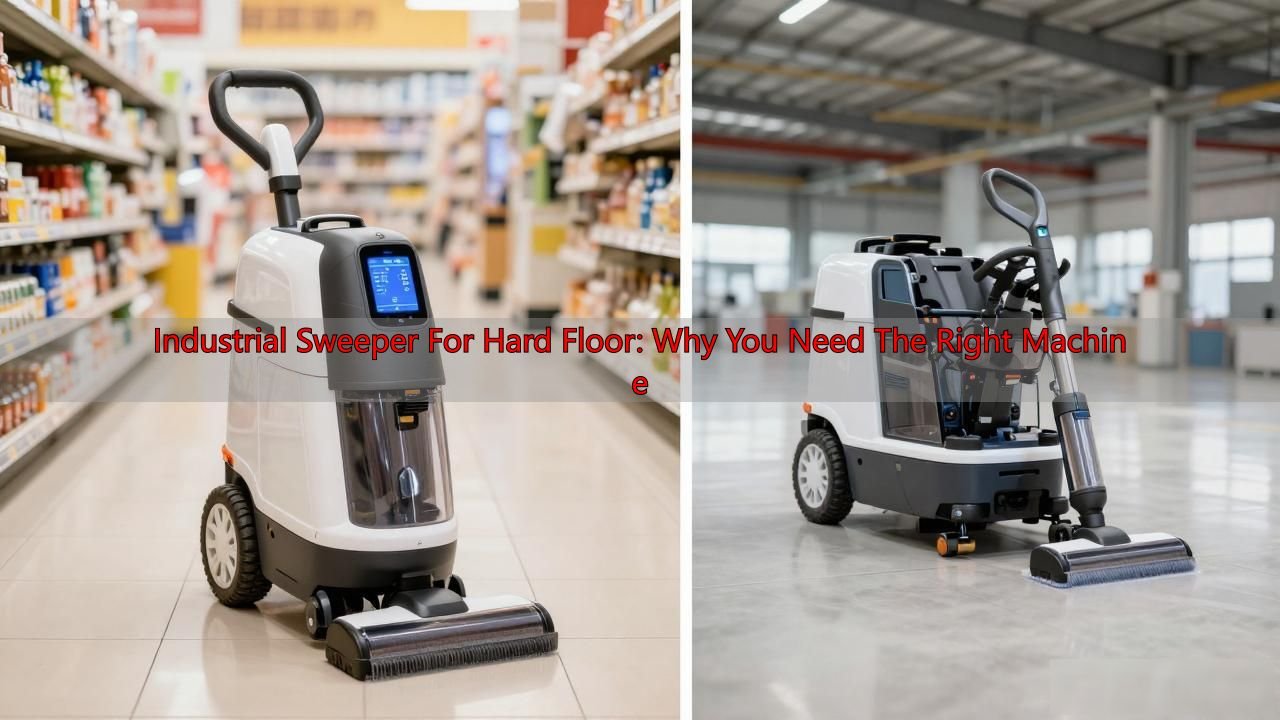
Question: Your current sweeper leaves a fine dust trail? That's because its brush speed exceeds 2,000 rpm Industrial sweeper for hard floor . Anhui Tanjie's intelligent controller reduces speed on hard surfaces to 1,200 rpm — cuts wear by 37%.
Application Scenarios: From Factory Floor to Showroom
Heavy industry : Steel shavings, welding slag. Polypropylene brushes survive 2,000 ชั่วโมง.
Food processing : Stainless steel components, washdown-rated body.
Pharma cleanrooms : HEPA + UV sterilization add-on.
One automotive client reported: “After switching to Anhui Tanjie’s hard-floor sweeper, our floor maintenance costs dropped 40% in 6 months.”
Global Reach, Local Compliance
Anhui Tanjie exports to 30+ countries. Each sweeper adapts to local electrical standards (CE, UL, CCC) and floor material variations.
Curious about your specific floor type?
The company publishes a “Hard Floor Sweeper Compatibility Matrix” — cross-referencing floor density, chemical resistance, and traffic load.
Conclusion: Choose by Surface, Not by Brand
An industrial sweeper for hard floor is not an accessory — it's a precision investment. Next time you specify, ask:
What brush material matches my floor's abrasion index?
Can the vacuum system capture respirable silica (0.1-1.0 microns)?
Does the manufacturer test on concrete of my exact psi?
มณฑลอานฮุย Tanjie อินเตอร์เนชั่นแนลเทรดดิ้ง จำกัด, บจ. answers these questions before shipment. Their hard-floor sweepers are documented — not guessed.
Final thought : The right machine doesn't just sweep. It preserves your floor's lifespan. Start with the surface, not the label.
[End of article — no further commentary]