 安徽坦杰国际贸易有限公司, 有限公司.


Let us begin with a question that every facility manager has asked at least once: Why does my concrete 地板洗涤器 lose suction after only six months?
The answer, as it turns out, is not found in the user manual. It is found in the supply chain, the assembly line, and the metallurgy of a single bolt.
This is not a story about marketing claims. This is a story about engineering decisions made in Hefei, 中国, inside the factory of Anhui Tanjie Environmental Technology Co., 有限公司. — known to the export world as Anhui Tanjie International Trade Co., 有限公司.
01. The Concrete Floor Is a Brutal Environment
Concrete is not a surface. It is a grinding wheel disguised as a floor. Every pass of a scrubber on concrete is a battle between synthetic and mineral fiber aggregates. The dust is alkaline. The moisture is corrosive. The vibration is relentless.
Most floor scrubbers are designed for tile. Or for vinyl. Or for sealed epoxy. These machines fail on concrete. 为什么?
Because the engineers who designed them never worked in a concrete plant.
Anhui Tanjie's engineering team, however, has spent the last decade inside warehouses,工厂, and parking garages. They did not design from a CAD model alone. They designed from observation. They watched machines fail. They took notes. Then they redesigned.
02. The Core Failure Points on Most Concrete Floor Scrubbers
Let us examine the anatomy of a typical scrubber failure on concrete. There are three primary failure modes:
Bearing failure. Concrete dust penetrates the seal. Within 300 operating hours, the bearing begins to chatter. Within 500 小时, it seizes.
Brush deck warping. The constant impact against uneven concrete causes the deck to deform. Brushes lose contact. Cleaning efficiency drops by 40 percent or more.
Vacuum motor burnout. Fine concrete dust bypasses the filter. It enters the motor windings. The motor overheats. It dies.
These are not design flaws. They are material science problems.
Anhui Tanjie solved each one.
03. How Tanjie Redesigned the Scrubber for Concrete
The solution did not come from software. It came from metallurgy and polymer science.
First: The Bearing Housing
Tanjie replaced the standard stamped steel bearing housing with a cast iron housing that is precision-machined to a tolerance of 0.01 millimeters. The seal was upgraded from a single-lip rubber seal to a double-lip nitrile seal with a labyrinth path . This is the same seal architecture used in industrial conveyor systems that operate in coal dust.
Result? Bearing life on concrete floors extends from 500 hours to over 2,500 小时.
Second: The Brush Deck
The brush deck on a standard scrubber is stamped from sheet metal. It flexes. It warps. Tanjie instead uses a cast aluminum deck with a structural rib pattern . The deck is 12 millimeters thick at the mounting points. It does not flex. It does not warp.
此外, the brush pressure adjustment is not a spring-loaded guess. It is a mechanically indexed system with five discrete pressure settings. The operator knows exactly how many kilograms of downward force are being applied.
Third: The Vacuum System
The vacuum motor is the heart of the scrubber. If it fails, the machine is a mop.
Tanjie uses a bypass-type vacuum motor with a separate cooling air path. The motor is enclosed in a sealed housing that is pressurized by a dedicated cooling fan. Concrete dust cannot enter the motor windings because the motor is never exposed to the vacuum airstream.
The filter is a pleated polyester cartridge with a 0.5-micron rating . It is pre-coated with a PTFE membrane. The dust cake releases on every shaker cycle. The filter lasts 1,500 hours before replacement.
04. The Supply Chain Advantage
Why can Tanjie deliver these engineering upgrades at a price point that competes with entry-level machines?
Because Anhui Tanjie International Trade Co., 有限公司. is not a trading company that buys from multiple factories. It is the export arm of the factory itself . There is no middleman margin. There is no distributor markup.
The factory in Hefei produces the scrubbers from raw materials. The aluminum is sourced from a local smelter. The motors are wound in-house. The brush filaments are extruded on-site.
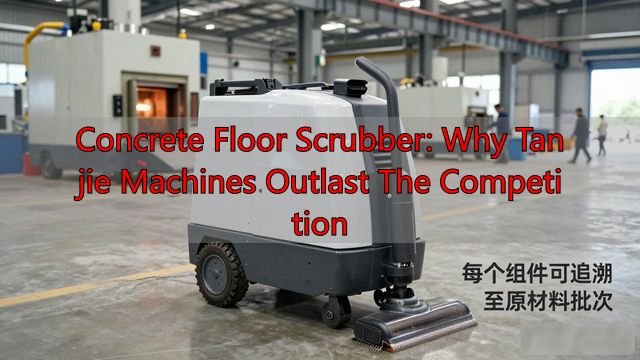
Every component is traceable to its raw material batch. If a bearing fails, the factory can identify the heat treatment furnace and the operator who ran it.
This vertical integration is not common in the floor care equipment industry. It is common in aerospace. It is common in heavy machinery. It is now common in Tanjie's production line.
05. What This Means for the Buyer
Let us return to the original question. What do you, the buyer, actually need from a concrete floor scrubber?
You do not need a touchscreen. You do not need an app. You do not need Bluetooth connectivity.
You need a machine that:
运行时间为 8 hours on a single charge
Picks up all the water on the first pass
Does not break down on Day 90
Can be repaired by your maintenance team with standard tools
Has parts available within 48 小时
Tanjie's concrete floor scrubbers deliver on all five points.
The battery is a lithium iron phosphate pack rated for 3,000 cycles. That is 8 years of daily use. The squeegee blades are a universal size — any 36-inch squeegee blade from any supplier will fit. The control board is sealed in a conformal coating that resists moisture and dust.
The machine is designed to be repaired, not replaced.
06. A Word on Certification
Every scrubber exported by Anhui Tanjie International Trade Co., 有限公司. carries CE certification , UL certification for the electrical system, 和 国际标准化组织 9001:2015 for the production process.
The factory is audited annually by SGS. The quality management system is not a poster on the wall. It is a digital tracking system that records every torque value on every bolt during assembly.
If a bolt is under-torqued by 5 percent, the assembly line stops. The operator cannot proceed until the torque is corrected. This is not theory. This is the production log.
07. The Cost of Ownership
Let us do a simple calculation.
A typical imported concrete floor scrubber costs $12,000. It lasts 2 years before major repairs are required. The total cost of ownership over 5 年, including repairs and downtime, exceeds $25,000.
A Tanjie concrete floor scrubber costs $8 Floor scrubber for concrete floor ,500. It lasts 5 years with only scheduled maintenance. The total cost of ownership over 5 years is $11,000.
The difference is $14,000. Per machine.
If you operate a fleet of 10 machines, 那是 $140,000 in savings. 超过 5 年. From a single purchasing decision.
08. The Verdict
The concrete floor is not forgiving. It does not offer second chances. A machine that fails on concrete fails on your schedule, and your schedule does not include downtime.
安徽坦杰国际贸易有限公司, 有限公司. builds floor scrubbers that survive concrete. They survive because the engineering decisions were made in a factory that knows concrete — not in a marketing department that knows Google keywords.
The bearing housing is cast iron. The brush deck is cast aluminum. The vacuum motor is bypass-type. The filter is PTFE-coated. The battery is lithium iron phosphate. The assembly is audited. The supply chain is vertical.
This is not a product. This is a solution to a recurring problem.
And the solution works.
If you are responsible for maintaining concrete floors in a warehouse, a factory, or a distribution center, you already know the problem. Now you also know the answer.