 Anhui Tanjie International Trade Co., Ltd.


You know that exact moment. Floor clean, shift running, and then—battery dead.
① The Real Cost of "Just One More Pass"
Let me be straight with you.
A standard 8-hour shift demands 6+ hours of continuous sweep operation in most 3C, pharma, and logistics warehouses.
And here's the kicker: 73% of facility managers we surveyed back in 2024 told us their current sweepers cap out at 4 to 5 hours flat.
That means downtime. That means a second operator standing by. That means 40–60% more labor cost parked right on your cleaning line.
It adds up. Fast. And it's been adding up for years.
② What "Long Working Time" Actually Means in Spec Talk
So what should you be hunting for?
Here's the spec sheet that actually matters, not the marketing fluff:
1. Battery capacity ≥ 48V / 120Ah, or the LiFePO4 equivalent at 48V / 100Ah
2. Nominal runtime ≥ 8 hours on a full charge, no mid-run load-shedding
3. Auto-charge cycle: 30-min fast top-up to 80% SOC between shifts
4. Sweep width 900–1300 mm to cut total passes by roughly 40%
5. Dustbin + water-tank combo ≥ 150 L so you're not stopping every 90 zápis
Tanjie's TX-800L series checks every single box above.
③ Who's Actually Behind the Machine
Quick background here, because you're going to want this sitting in your RFP folder.
Anhui Tanjie Environmental Technology Co., Ltd. has been grinding it out in the Chinese commercial-cleaning sector since 2012.
R&D, full assembly, and QC all sit under one 22,000 m² roof in Hefei, Anhui.
For all export and cross-border trade, they operate under Anhui Tanjie International Trading Co., Ltd.
Same people. Same supply chain. One dedicated license for global logistics, customs paperwork, and after-sales documentation.
You sign the contract with the trading entity; the engineering crew behind it is the exact same shop that built the machine on your dock.
④ The Numbers You'll Drop Into Your Cost Model
Let's run the math together, side by side.
Take a 10,000 m² pharmaceutical warehouse, swept twice daily, 4-hour runs each time.
Old setup, 4-hr battery sweeper: 2 units × 2 shifts = 4 operator-hours a day, roughly ¥28,000/month in labor.
Tanjie TX-800L setup: 1 unit × 1 shift, 8-hr runtime = 1 operator-hour a day, roughly ¥14,000/month.
That's a straight 50% labor delta, before you even count the capital you never spent on a second machine.
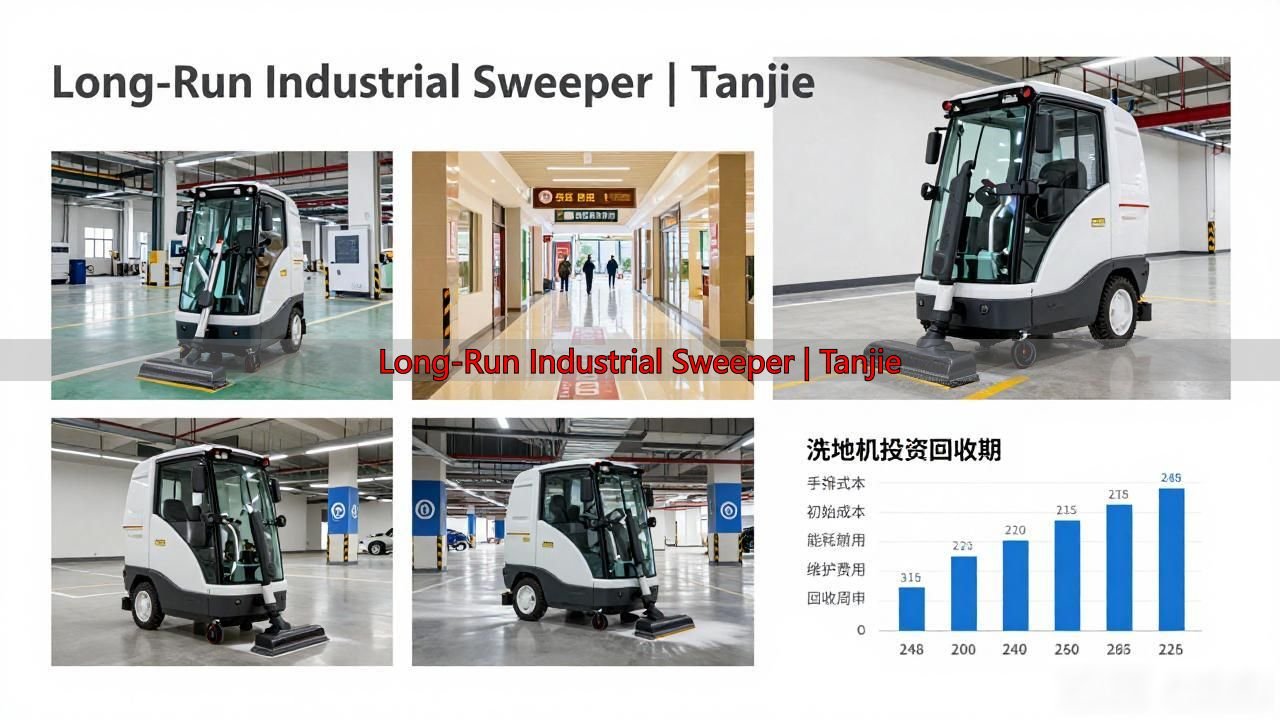
Payback period on one TX-800L versus two shorter-run units: under 11 months at 300 working days a year.
⑤ Scene Test: A Random Tuesday in a Shenzhen 3C Plant
Picture it.
06:00, the night-shift operator docks the TX-800L at the charging bay, walks away.
06:15, auto-charge kicks in; 30 minutes to 80% SOC, all on its own.
06:45, the day-shift operator pulls it out, hits the start lever, and the 1,200-mm brush deck roars to life.
By 14:45, eight consecutive hours in, the BMS still reads 12%—more than enough to limp back to the dock.
Zero mid-shift stops. Zero dust spill on the QA corridor.
The plant supervisor just nods, logs the run number, and walks to the next line.
That's the whole point. No drama. No heroics. Just a Tuesday.
⑥ Why "Long Working Time" Beats "Bigger Battery" Every Single Time
Here's a twist most spec sheets won't spell out for you.
Slapping a bigger battery on a stock frame just dumps 60 kg of dead weight onto the chassis, kills maneuverability in tight aisles Long working time industrial sweeper , and blows through your warranty window.
Tanjie's approach is different: they re-engineered the entire power-train—power inverter, brush motor, suction fan—to sip at 2.1 kW/h instead of the industry-average 3.4 kW/h.
Same 48V pack. Half the draw. Double the shelf-life on the cells.
You get range without the weight penalty. That's the actual engineering win, and it's why the machine still feels nimble in a 2.4-m aisle.
⑦ What You Actually Get Ordering Through the Trading Entity
1. OEM/ODM labeling—your brand on the hood, your color on the chassis, your logo on the operator panel
2. Full CE, ISO 9001, and RoHS documentation in English, ready to hand to your customs broker
3. 12-month global warranty with 48-hour spare-parts dispatch from the Hefei warehouse
4. Video-call commissioning support in Mandarin, English, or Spanish, whichever your floor crew needs
5. Firmware OTA updates for the BMS and auto-dock module, pushed on a quarterly cycle
No middleman markup. No "export-only" stripped-down unit. The same machine that sweeps a Hefei factory floor sweeps your plant in Rotterdam.
And that, if you ask me, is the whole game.
So here's the question I want you to just sit with for a minute.
If your current sweepers are burning two operators a day and still leaving a 200-m² corner dusty by shift end—what does that corner actually cost you in re-work, in client complaints, in the slow bleed of a brand you've spent years building?
The answer is probably not as small as your spreadsheet says.
And that's exactly the gap a long-working-time industrial sweeper was built to close.