 Anhui Tanjie International Trade Co., Ltd.


1. The Floor Is the Problem
Kráčejte za průmyslovým zametačem machines have been the standard tool of commercial cleaning for decades, and they still move product the way a factory floor moves in a busy shift.
What most buyers actually need is not a bigger machine but the right size for the space they already operate in.
You walk into a warehouse in Hefei and you see the same pattern: a 2,000-square-meter bay with a walk-behind unit running along the picking lanes while a ride-on unit handles the wider cross-dock.
That split is where the real value sits Kráčejte za průmyslovým zametačem , and it is the reason Tanjie ships both types under one roof.
2. How the Unit Got Here
The walk-behind industrial sweeper started as nothing more than a wide brush on a motor frame, and by the late 1980s factories in Europe were already running them through night shifts.
Then the brush material changed, the suction motor got lighter, and the whole package dropped below one hundred kilograms, which meant a single operator could run it for a full eight-hour shift without fatigue.
That weight drop changed everything, because the moment a machine fits one person the labor math stops being a problem and starts being an advantage.
Tanjie picked up that same logic a decade later, and the export line through Anhui Tanjie International Trading Co. kept the hardware simple enough that a forklift driver in a third-country plant could learn the controls in an afternoon.
3. What the Numbers Look Like Today
Right now the global walk-behind sweeper market sits somewhere around the $280 million mark, and the growth curve has been flat for the last three years, which is unusual for a category that ties directly to warehouse throughput.
The flatness tells you something: most of the units that need replacing have already been replaced, and the new demand is coming from facility expansion rather than replacement cycles.
Tanjie's export data from the last two years reflects that shift, with more orders coming from new cold-storage facilities in Southeast Asia than from retrofit projects in older plants.
A walk-behind unit on a 1,500-square-meter line will clean roughly 800 square meters per hour with a two-person rotation, and that number is the benchmark buyers keep asking about.
4. The Comparison of Nobody Prints
If you put a walk-behind unit next to a ride-on unit on the same 3,000-square-meter floor, the walk-behind handles tight aisles and the ride-on handles open spans, and neither one handles a floor that is 60 percent racking and 40 percent open.
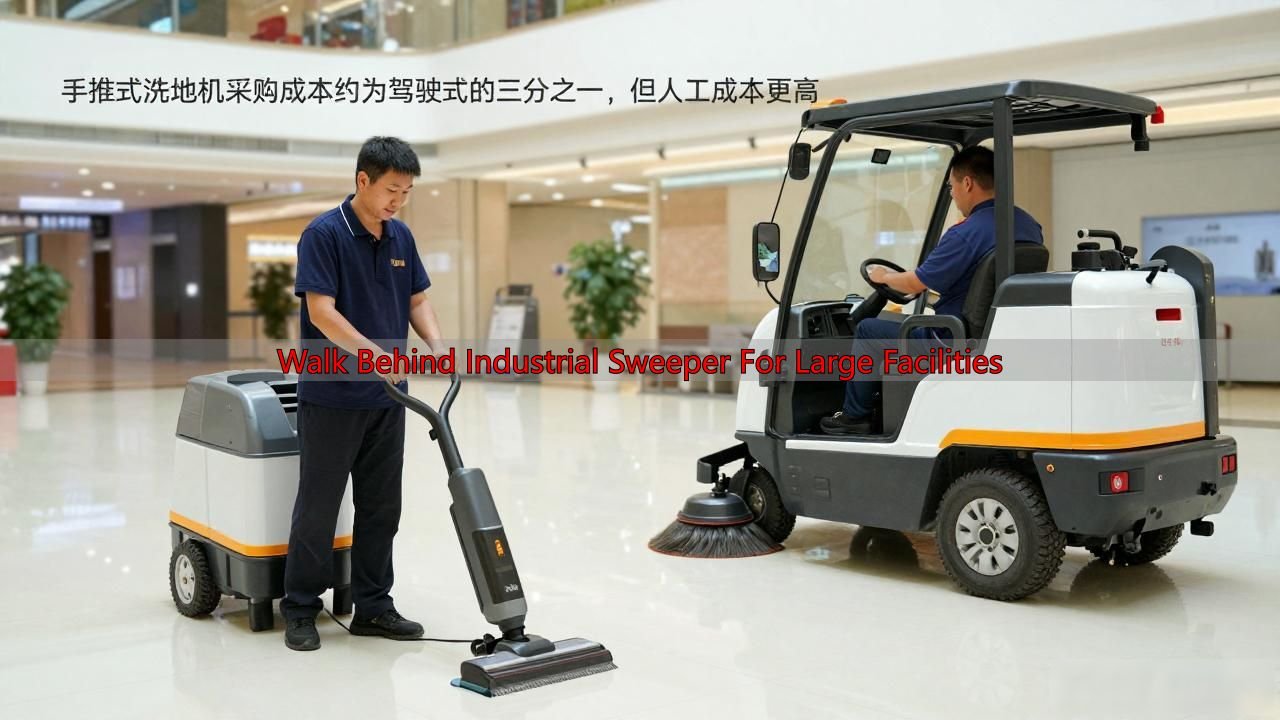
The cost gap is also real: a walk-behind machine runs at roughly one-third the purchase price of a comparable ride-on, but the operator cost per hour is higher because one person is tied to the machine for the full shift.
What that means in practice is that the total cost of ownership crosses over at about 4,000 square meters of daily cleaning area, and below that number the walk-behind is almost always the smarter buy.
Tanjie publishes that crossover figure in every quotation sheet, which is why the export team under the International Trading entity gets asked to walk buyers through the math before they commit.
5. Where the Next Three Years Are Pointing
The next generation of walk-behind industrial sweepers is going to look almost the same, but the control stack underneath is already different, and that is where the money is moving.
Sensor-based brush pressure adjustment and LiDAR-assisted path planning are both in prototype at three of the major OEMs, and both will land in the export market within 24 months.
What that means for a buyer in 2026 is that a machine purchased this year will hit a software ceiling, and the upgrade path will be a firmware update rather than a new brush drum.
Tanjie has already flagged that ceiling in the product documentation, and the recommendation to customers is simple: buy the hardware that matches today's floor, and keep the software conversation open for the next cycle.
6. The Warning That Actually Matters
The most common mistake is buying a walk-behind unit for a floor that is going to change size in eighteen months, and when that floor change happens the machine is either too small or the wrong configuration entirely.
The second mistake is skimping on the dust-collection bag and replacing it only when it stops working, which cuts the effective suction in half and sends fine particulate back into the air stream of a working plant.
Both of those mistakes cost more over a three-year horizon than the price gap between a base model and a mid-spec model ever will.
So the practical answer is to size the unit for the floor you expect in year two, not the floor you have in year one, and to treat the consumables schedule as a fixed line in the operating budget rather than a maintenance afterthought.
7. Where the Conversation Ends
The walk-behind industrial sweeper is not going anywhere, and the export pipeline through Anhui Tanjie International Trading Co. is tracking steady through the fourth quarter.
What is shifting is the question buyers ask, because the question has moved from "does it clean" to "does it clean and report back to my dashboard."
That is the real future of the category, and the buyers who plan around it now will have a cleaner floor and a cleaner data trail at the same time.