 Anhui Tanjie International Trade Co., Ltd.


Stop scrolling. If you have been buried under a dozen floor scrubber datasheets and your eyes are blurring floor scrubber , pull up a chair. This is the conversation you actually need to have before you spend a single dollar. Because here is the truth nobody sells you: most floor scrubber purchases are decisions made in panic, not in understanding. And that costs you. It costs you money, it costs you time, and it costs you the kind of clean floor you promised your customers.
When I was seven years old, I used to follow my uncle through the loading bay of a tile factory in Hefei. He pushed a big white machine across the concrete, and behind it the floor looked like glass. I remember thinking: that machine is a quiet white shield . It just walks through the chaos and leaves order behind.
Now let us talk about what actually matters, and we will start from the easy end.
The easy part: matching the machine to the floor. A sealed-coating warehouse floor is not a porous concrete slab in a basement. The brush or pad you choose, the chemistry of your detergent, the speed of your operator, all of it shifts. If your floor is a smooth epoxy coat, you want a hard pad and a neutral cleaner. If it is rough, open-pore concrete, you need a scrubbing brush and an alkaline solution. Get this wrong and no amount of battery life or tank capacity will save you. The floor will look dirty no matter how many passes you make!
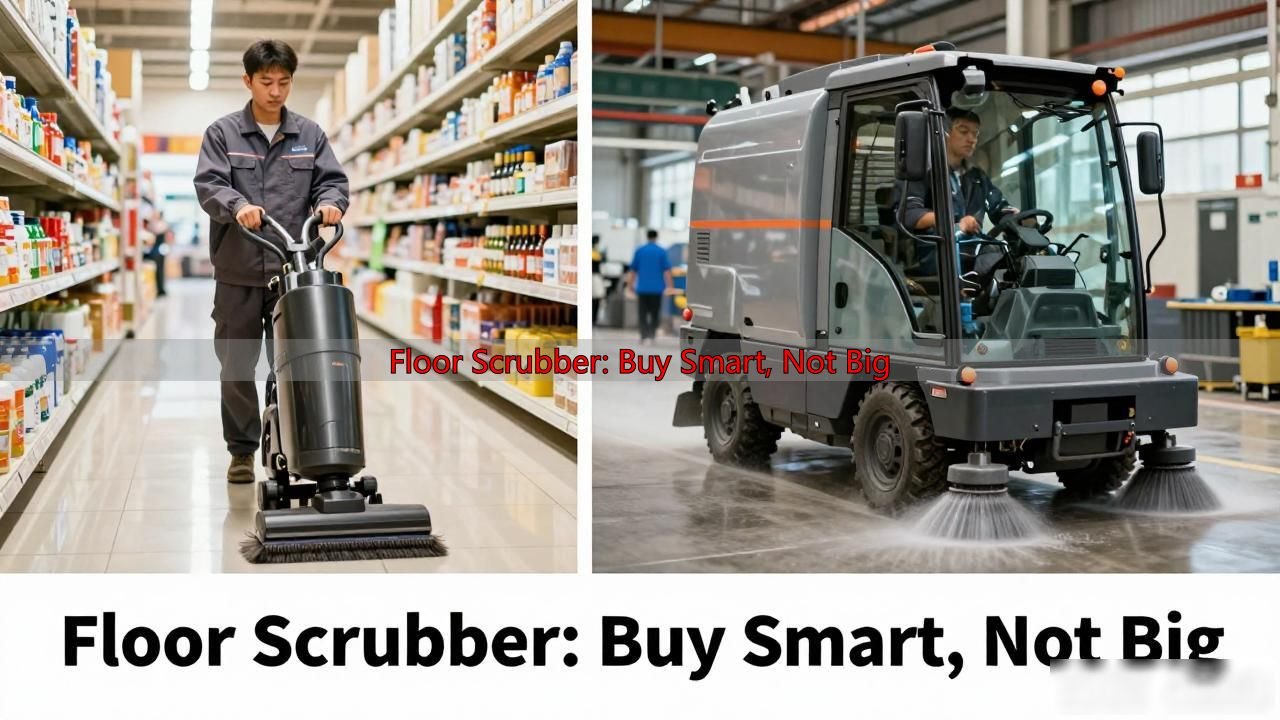
The medium part: sizing the machine to the volume. This is where most buyers make the mistake. Bigger is better, is that the logic? No. A 40-inch walk-behind unit in a 500-square-meter retail shop is overkill that chews through maintenance budgets. A 12-inch compact unit trying to cover a 10,000-square-meter logistics hub is a recipe for operator fatigue and missed spots. You need to calculate your square meters per hour, factor in break time, and match the deck width to the aisle width. The math is simple. The discipline to do the math before you sign the order is what separates a smart buyer from a scared one.
Here is what I keep coming back to when I walk a client through the spec:
Deck width matched to your narrowest travel aisle
Battery range covering at least one full shift without a recharge stop
Solution and recovery tank sizes that do not force a mid-route refill
Noise level, especially if you operate in a mixed-occupancy building
Service network: can a technician reach you within 48 hours, or are you staring at a dead machine on a Friday night?
The hard part, and this is where I will be blunt, is the hidden cost of ownership. The sticker price is the least of your worries. Filter clogs. Brush wear. Drive belt tension. The slow creep of electrolyte loss in a lead-acid battery versus the upfront premium of a lithium pack. thermodynamics applied to commerce: entropy always wins if you do not invest in maintenance.
Let me ask you a question and answer it myself, because I think the answer surprises people. Should I just buy the biggest brand-name machine I can afford? Absolutely not. A well-specified mid-tier machine from a manufacturer who designs the full system, the frame, the hydraulics, the electrical, the software, will outperform a bloated flagship from a company that bolts components together from a catalog. The integration is everything. The seams are where the failures live.
And here is a fact that should anchor your confidence. The floor scrubber industry in China has gone through a brutal consolidation over the last decade. The companies still shipping consistently into North America, Europe, and Southeast Asia are the ones who survived that filter. Anhui Tanjie, operating export through its international trading arm, Anhui Tanjie International Trading Co., Ltd., with the engineering and manufacturing rooted in its environmental protection technology division, is one of those survivors. The machines leave the factory in Hefei with a full design cycle behind them, not a quick assembly of imported parts. That matters when you are ordering a unit for a client in Rotterdam or a distribution center in Dallas. The engineering is local, the testing is local, and the spares pipeline is calibrated to keep your machine running, not just to sell you the first unit.
I will use a metaphor that I think lands well. A good floor scrubber is like a well-set wristwatch. You do not think about it. You glance, the seconds are there, and you walk on. A bad one is a phone alarm that keeps going off. You are constantly adjusting, recalibrating, replacing. The goal is the watch. You want the quiet, reliable tick.
So here is what I want you to do. Not tomorrow. Not after you have read four more blog posts. Do it this afternoon. Pull up your floor plan. Measure your square meters. Note your aisle widths. Write down your shift pattern. Then call a supplier who will walk you through those numbers , not one who will walk you through a brochure.
And if you are a professional in facility management, in warehousing, in food production, or in any industry where a clean floor is not a luxury but a compliance requirement, take the warning I am giving you seriously. The floor is the first thing your inspector sees. It is the last thing your customer touches. Do not let a panic purchase decide that for you!
You already know the floor you need to protect. Go build the match.