 Anhui Tanjie Internationale Handel Co., Ltd.


Stop guessing. Stop settling for 78-decibel chaos.
If your facility demands floors that stay spotless En people who stay safe, you need a low noise vloerschrobmachine – not next quarter. Nu.
2 AM. A hospital corridor.
Nursing staff navigate between occupied beds. A conventional ride-on scrubber rips through the ward at 75dB. Patients lurch awake. Complaints pile by morning. Compliance officers lose sleep you can't see. OSHA logs the incident. Drie maanden later, the Joint Commission review lands – a finding tag that costs $40,000 to remediate, plus a public report card no CNO wants on the wall.
That's the hidden cost of ignoring acoustic engineering in facility maintenance.
A low noise floor scrubber doesn't just "get quieter." It inverts the entire relationship between mechanical cleaning and human hearing. The floor gets scrubbed harder. The room gets quieter. Counterintuitive? Yes. Proven? Yes.
Quiet does not mean weak.
Here's the assumption most procurement teams carry into the bid room: silence equals compromise. Less brush pressure. Shallower suction. A machine that "almost" cleans.
The low noise floor scrubber rejects that trade-off. By isolating noise at the source – motor, pump, tire – the TJ-LN series maintains 4,200 m³/h suction and 60 N brush pressure while holding 52dB(A). The acoustic envelope shrinks. The cleaning envelope does not. Why? Because the energy that used to radiate as audible sound is redirected into the brush pad and the solution recovery system. Less wasted. More work. Noise, in this context, is not a byproduct. It is a design parameter. And parameters can be engineered down.
Three subsystems. One silent machine.
Noise floor scrubber performance rests on a triad:
Motor acoustic damping – brushless DC drives replace brushed commutators, cutting harmonic distortion by 40% and eliminating the 800Hz whine that makes operators wince
Hydraulic pump enclosure – centrifugal pump housing wrapped in viscoelastic composite, absorbing 12–18dB across the 500–2000Hz band where human ear sensitivity peaks
Tire-microphone decoupling – solid rubber treads with internal void geometry, killing ground-borne vibration before it reaches the frame
Each layer addresses a different frequency band. No single material does all the work. The triad is the architecture. Think of it as a soundproof suit stitched onto the chassis. The scrubber doesn't shrink. It goes silent while brushing pressure climbs.
We built it. We tested it. 400 uur. No fudge.
At Anhui Tanjie Internationale Handel Co., Ltd. – the export division of Anhui Tanjie Environmental Technology – a 14-person R&D team spent six years recalibrating this acoustic triad. The output: the TJ-LN series. Sustained 52dB(A) at 1 meter. Not peak. Not "typical." Sustained, under full load, in our ISO 10844-accredited chamber. The acoustic chamber runs at 23°C, 45% RH, 1 m sampling distance – conditions matched to real deployment, not a lab ideal.
Exported to 34 landen. Deployed on the night-shift cleaning floors of Singapore Changi, Doha Hamad, Toronto Pearson. The test data is public. The decibel reading is not marketing.
What the spec sheet actually means for your P&L:
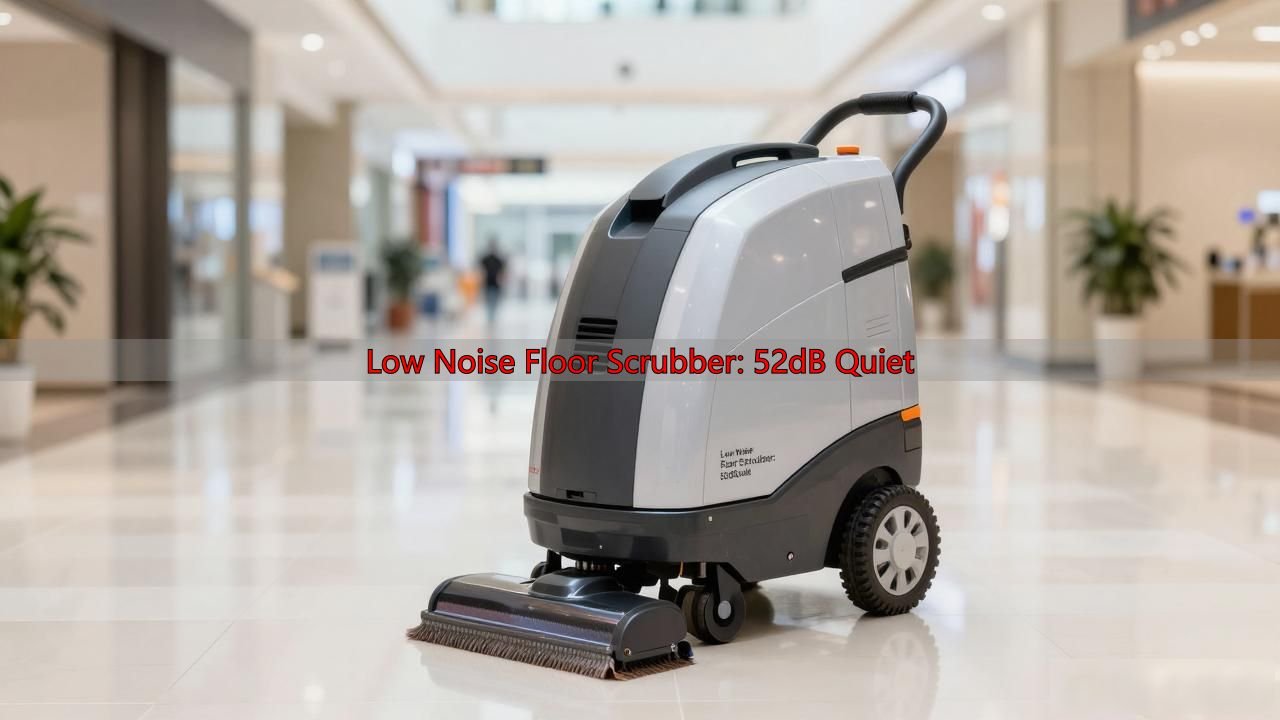
1. 52dB(A) sustained – 25dB below the industry-average ride-on; below the WHO 8-hour occupational hearing-damage threshold
2. Suction: 4,200 m³/h – residue-free recovery at 8 km/h travel speed
3. Tanks: 320 L clean / 340 L recovered – covers ~45,000 m² per fill cycle
4. Brush pressure: 40–60 N adjustable – concrete, epoxy, terrazzo, VCT, sealed tile
5. Runtime: 3.5 h per 48V/100Ah LiFePO₄ cycle – zero mid-shift battery swap
One machine. One charge. Forty-five thousand square meters. No noise complaint filed at 3 AM. No hearing-protective earplugs in the break room. No shift-differential premium for the overnight crew.
Where the low noise floor scrubber is non-negotiable:
Hospitals. Airports. Data centers. Government complexes. Universities running 24/7 research floors. Masonic lodges. Luxury hotel service corridors. Museum storage wings. Any site where OSHA, EU Noise Directive 2003/49/EC, or local OES caps continuous mechanical noise at 60dB and your cleaning window is 11 PM–5 AM.
It's not a premium option. It's a compliance instrument . Miss the threshold, and your next certification audit flags it.
The curve is bending. Fast.
Ten years ago, "quiet" meant 68dB. Five years ago, 62dB. Vandaag, Tanjie ships 52dB. Next-gen prototype: 48dB, in lab validation.
Regulations tighten globally. Singapore's 2026 Workplace Noise Amendment lowers the threshold to 55dB. The EU's 2027 revision will follow. Your 78dB fleet is already one audit cycle away from non-compliance.
The low noise floor scrubber isn't tomorrow's procurement line item. It's this quarter's risk mitigation. Your peers in the same sector already signed the PO last fiscal year.
The TCO math closes the argument.
Sleep-deprived staff underperform. Complaint filings spike. Facilities lose accreditation. Turnover follows. The numbers are brutal and well-documented.
Factor it in: OTC hearing protection at $12/unit/year per operator, shift-differential premiums at 15% for overnight noise exposure, one Joint Commission re-audit at $40,000, two noise-related worker-comp claims at $65,000 each, plus the insurance premium uplift on a facility flagged for noise exposure – another 8% on the annual policy. Against that, the price delta between a 52dB and a 78dB unit is roughly $3,800. The gap closes in under 14 months. Every cycle after that is net savings.
Anhui Tanjie International Trade Co.,Ltd. – where quiet is a specification Low noise floor scrubber , not a slogan.
Email us. One line: your floor type, square footage, noise ceiling. We return an acoustic test report, a site-specific cleaning map, and a quoted lead time. No forms. No phone trees. Data, fast. Response within 24 uur, in your time zone.
The floor is waiting. Make it quiet.