 Anhui Tanjie Comércio Internacional Co., Ltda.


The warehouse door slides open. Cold air carries the smell of wet concrete and citrus detergent. A forklist in a reflective vest pulls a fifty-kilogram unit from the rack. No middleman tag. No distributor markup stitched into the invoice. Just a machine, stamped with a factory code, waiting for a container.
This is where "factory price" stops being a slogan. It becomes a number on a line item.
Strip the term to its bones. In the floor-care equipment sector, the gap between ex-factory cost and retail shelf price often spans forty to sixty-five percent . Where does that margin go?
Channel commissions, two to three tiers in most Western markets
Local warehousing and compliance-certification fees
Warranty reserve funds held by the import brand
Advertising overhead that the end user pays for every unit
UM factory-price esfregão de chão bypasses the last three lines. The buyer negotiates with the production floor directly. The price reflects steel, brush motors Factory price floor scrubber , squeegee assemblies, and labor hours—nothing else.
For a senior procurement lead walking a trade-show aisle or scrolling a supplier database, these parameters decide whether a unit lands on the loading dock or back in the inbox:
Brush diameter: 13 in. to 27 in. (industrial range)
Water-tank capacity: 40L to 150L
Coverage rate: 1,500 to 5,500 m²/h
Battery chemistry: Li-ion versus lead-acid (a twelve-month TCO swing of roughly twenty-two percent)
Deck material: SS304 or PP (PP cuts unit cost by about eighteen percent; SS304 outlasts in chloride-heavy or food-plant environments)
Squeegee length matched to deck width, rated in both dry and wet wipe cycles
Reverse the usual logic. Most buyers ask, "Can the factory hit my target price?" The sharper question is, "What does that price exclude ?" A quoted unit at a factory-competitive rate that omits the charging station, the spare-brush kit, or the CE declaration of conformity will erode savings within the first service cycle.
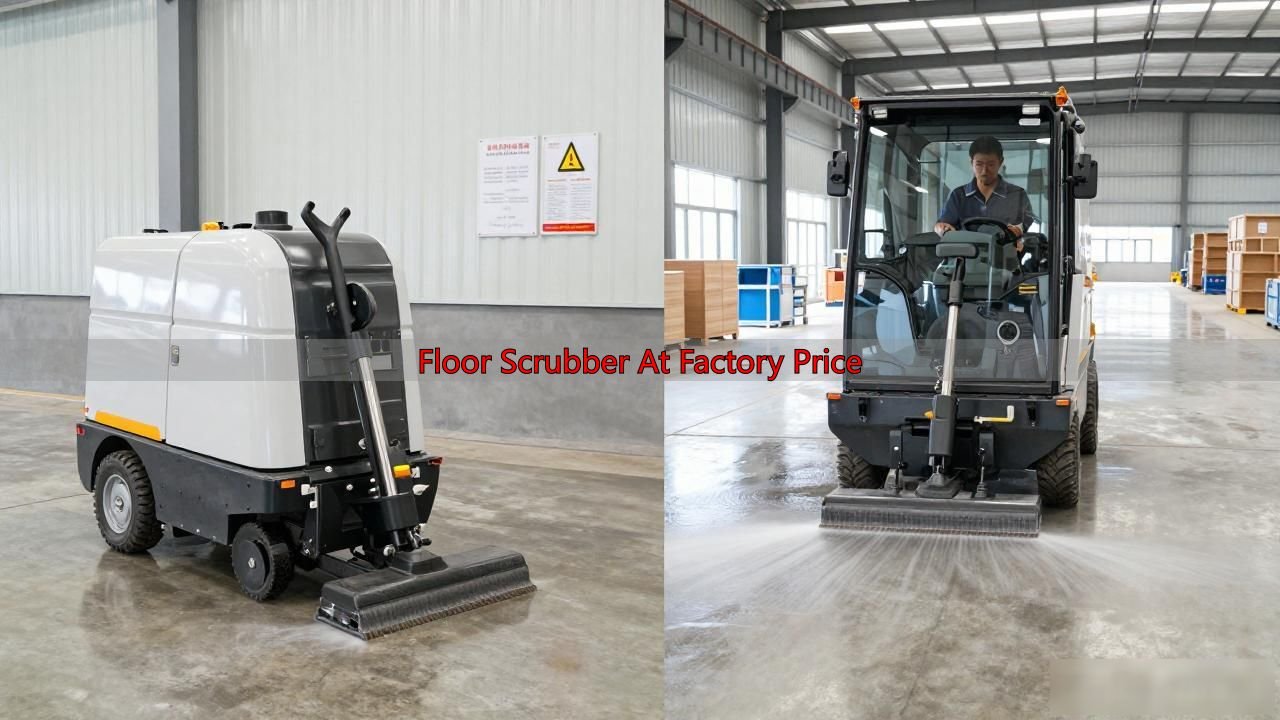
A structured BOM—bill of materials—shared before order placement removes that ambiguity. It lists every component, its grade, and its replacement interval. The buyer signs against the BOM, not against a brochure.
The name on the commercial invoice for export orders reads Anhui Tanjie Comércio Internacional Co., Ltda. The R&D bench, the assembly lines, and the post-sale technical desk sit under Anhui Tanjie Tecnologia de Proteção Ambiental Co., Ltda. One company, two registration shells—one for domestic operations, one for cross-border trade.
What that structure signals to a purchasing committee:
Export documentation (bill of lading, certificate of origin, packing list) is handled by a dedicated trade entity, reducing customs-hold risk at the port of entry
Engineering support traces back to the same facility that ran the unit on the production floor; no "we just sell, the factory is elsewhere" handoff
Spare-part lead times stay within the original production schedule because the trading entity does not source from a third-party OEM
Disputes and warranty claims resolve through a single invoice counterparty, not a chain of agents
Q1 orders spike as European cleaners prep for the spring deep-clean cycle. Q4 tightens as factories close their fiscal-year procurement windows. UM factory-price floor scrubber ordered in February typically ships within twenty-five to thirty-five working days. The same order placed in November may queue to mid-January. Timing is not a footnote; it is the variable that determines whether the machine is on the floor when the new lease starts.
What the buyer walks away with:
A unit priced without a channel layer
A single-point technical contact from unpacking to the 8,000-hour service milestone
A replacement-parts catalog indexed to the machine's serial number
A trade-compliance file that clears the port in one pass
A BOM that the next shift operator can hand to a local service tech without translation
The floor outside the factory gate is still wet. The forklist has gone inside. The container seal clicks shut at sixteen forty, and somewhere between here and a loading dock in Rotterdam, the question "is the price actually factory-level?" dissolves into a line item, a tracking number, and a machine that hums at six in the morning, long before the plant shifts clock in.
The next order is already in the queue.