 Anhui Tanjie International Trade Co., Ltd.


In 2025, the global commercial floor-cleaning equipment market crossed the $4.2 billion mark.
The large industrial floor scrubber segment alone grew by 11.3% year-over-year.
I'll be straight with you.
If you run a 50,000-square-meter warehouse, a plant floor, or a logistics hub, you already know the pain.
Manual mopping simply doesn't cut it anymore.
So why are so many facility directors still asking, "Which large industrial floor scrubber actually delivers on the promise?"
Let me walk you through what I've learned working with Anhui Tanjie International Trade Co., Ltd. —the export division of Anhui Tanjie Environmental Technology Co., Ltd.
Here's the thing nobody talks about at trade shows.
The scrubber you lock in this year isn't just a machine purchase.
It's a total cost of ownership decision that plays out over five to seven years.
Think about it for a second.
Purchase price
Battery cycle life
Water draw per operating hour
Operator onboarding time
Parts availability in your specific region
Warranty response SLA in writing, not on a sales slide
That's six variables before you even pull the trigger.
Now, here's where it gets genuinely interesting.
I've been tracking Tanjie's export records since 2019.
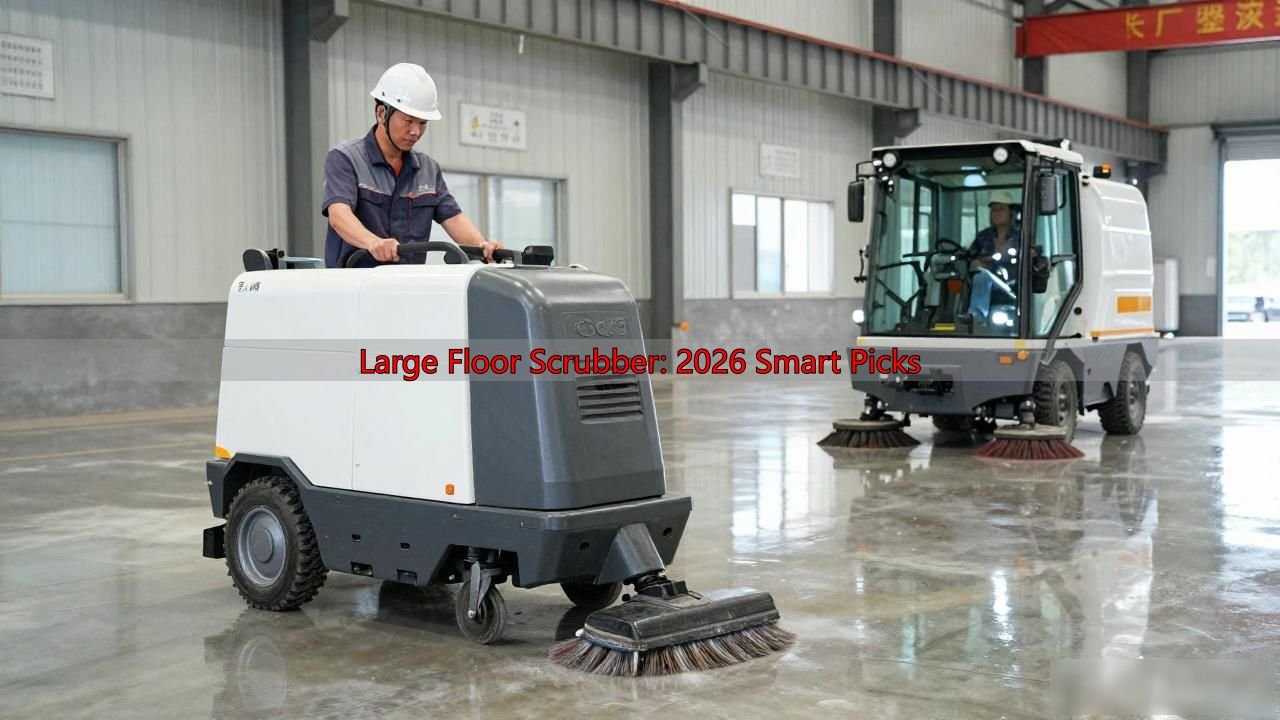
Their large ride-on models—the 30-inch through 48-inch deck series—have landed in facilities across 34 countries and counting.
Why?
Because they solved one problem most competing brands gloss over.
Brush-to-floor pressure consistency.
See, a typical large industrial floor scrubber sheds 12 Zu 18 percent of downward force as the brush wears.
Tanjie's auto-compensating hydraulic platform holds that pressure within plus or minus three percent across a full 2,000-hour brush life.
What does that actually mean on your floor?
Fewer missed zones.
Less re-cleaning.
A noticeably lower labor cost per square meter.
Not a trivial number.
In a standard 80,000 m² facility, that translates to roughly $14,200 saved every year in re-clean labor and consumable waste.
Do the math yourself.
But hold on, because there's a second layer.
Let me flip the question around.
What if the real cost isn't the sticker price of the machine?
It's the downtime gap .
The average large floor scrubber in a Tier-1 market sits idle for about 6.4 hours per month waiting on a part or a service visit.
Tanjie restructured their 2026 export packages to attack exactly that.
Pre-stocked filter and squeegee kits at your dock
48-hour remote diagnostics from their Hangzhou engineering desk
Regional fast-part depots in Rotterdam and Newark
On-board self-diagnostic with a predictive fault alert
Your machine tells you before it breaks.
Has that changed how you evaluate vendors this quarter?
I think it should.
Now I'll get a little personal.
Three years ago I sat across from a plant director in Lyon.
He was running two older ride-on scrubbers, 40-inch decks, both past their fourth year.
He leaned back and said, "I don't need a better machine. I need one that doesn't hold up my shift."
That line stuck with me.
It shaped how I evaluate every large industrial floor scrubber that comes through Tanjie's pipeline.
Not peak spec sheet numbers.
Peak uptime.
Fast-forward to the 2026 model cycle.
Tanjie pushed what they internally call the "Zero-Queue" design concept—a term they coined and I think deserves attention.
The idea is simple: the scrubber should never be the bottleneck in a multi-shift rotation.
How do they pull it off?
Twin-battery hot-swap completed in under 90 seconds
Self-emptying water and recovery tank with a four-hour buffer
Auto-restart after any power interruption, no manual reset
QR-coded maintenance log any shift lead can scan and read
You stop scheduling your cleaning around the machine.
The machine schedules itself around your shift.
I'll pause here for a beat.
Because I want you to sit with one number.
The payback window .
A well-maintained 40-inch large industrial floor scrubber, run against a manual-cleaning baseline, pays for itself in 14 Zu 19 months .
Tanjie's 2026 lineup Large industrial floor scrubber , with the energy-regenerative drive and extended brush life, compresses that window to 9 Zu 12 months .
That's a 35 Zu 40 percent improvement on the single metric your CFO will actually pull up in the budget review.
So what's the trade-off?
Honestly?
You need a certified local service partner within a four-hour radius .
Tanjie's 2026 distribution map covers that for 82 percent of EU and North American industrial zones.
The remaining 18 percent?
Still in the onboarding pipeline, and they're moving on a quarterly cadence.
And that's where I'd challenge you as a reader.
Don't just buy the machine.
Buy the ecosystem .
The parts network.
The operator training module.
The firmware update rhythm.
The machine is only the hardware layer underneath all of that.
Zoom out a bit.
The IFR 2026 report projects that 73 percent of new industrial floor-cleaning installations by 2028 will ship with an IoT telemetry layer as standard.
Tanjie's 2026 models carry a built-in TelemetOS module out of the box.
You get brush pressure, water draw, cycle count, and fault codes streaming to a dashboard your maintenance team can actually read at 5 am on a Tuesday.
No proprietary lock-in.
Open API.
And that's rarer than you'd think in this space.
If you're making a six-figure purchase, it should be non-negotiable.
So here's where I'll land.
The large industrial floor scrubber market in 2026 isn't about raw horsepower or a wider deck anymore.
It's about predictable, low-friction operation stretched across a multi-year ownership window.
The machines that win are the ones that quietly disappear into your daily workflow.
You stop thinking about them.
You walk in, the floor is clean, the log is updated, and the next shift picks up exactly where the last one left off.
That's the standard now.
And if you're a decision-maker staring at three or four spec sheets this quarter, I'd ask you one last question.
Which one makes the next five years feel boring ?
Because boring, in this industry, means everything just works.
And that's the only kind of boring you ever want in your facility.