 Anhui Tanjie International Trade Co., Ltd.


Stop paying for two shifts of sweeping. One machine should do both.
You run a 4,000 m² warehouse. Your current industrial sweeper dies at hour six. You swap batteries, lose forty minutes, pay overtime to a second operator. Multiply that by 250 working days a year, and the "cheap" sweeper costs you roughly $18,000 in hidden labor and downtime before you even touch the maintenance bill. That's not a machine problem. That's a margin problem.
The fix is simple in concept: you need a long working time industrial sweeper that outlasts the shift. Not "lasts a little longer." Lasts the whole thing, then some.
## 1. What "Long Working Time" Actually Means (And Why Most Claims Are Fluff)
Let's be blunt. Most manufacturers print "8-hour runtime" on a spec sheet Long working time industrial sweeper ,tested at 30% load on a smooth concrete floor, with a perfect 40 Ah battery pack, in a 25 °C lab. Your floor is not that floor. You've got 15 mm gravel, 3 °C ambient in November, and a 1.2-tonne payload of debris. Real-world runtime? Five hours. Maybe four.
Here's the data that matters:
Battery chemistry. LiFePO₄ packs deliver 20–30% more usable capacity over their lifespan compared to lead-acid. A 48 V / 100 Ah LiFePO₄ system rated at 5.28 kWh gives you a realistic 10–12 hours at medium load before you hit the 20% reserve threshold.
Motor efficiency. BLDC (brushless DC) drive motors run 12–18% cooler than equivalent brushed motors. Less heat means less thermal throttling, which means the controller doesn't dial back power in hour seven.
Airflow design. A well-angled fan housing with dual-stage cyclone separation reduces suction loss by up to 22% versus a single-stage design. Your vacuum motor works less. Your battery drains slower.
When Tanjie engineers in Hefei put a 48 V / 120 Ah LiFePO₄ pack behind a dual-BLDC drive on their TJJ-3500 model, the bench test at 100% throttle held 12.4 hours continuous. That is not a spec-sheet number. That's a logged, repeatable test.
## 2. Why Decision-Makers Should Care (Beyond the Obvious)
You're not buying a broom. You're buying floor uptime .
Consider the reverse: what happens if the sweeper stops at hour nine? In a pharmaceutical plant, a dirty floor is a GMP violation . In a food-processing warehouse, it's a HACCP audit failure that can halt production for days. In a logistics hub, it's a customer complaint about packaging dust. The cost of a two-hour stoppage is not the cleaning crew's wages. It's the downstream penalty no one budgets for.
A long-working-time industrial sweeper isn't a comfort feature. It's an insurance policy against operational blind spots.
## 3. The Tanjie Approach (Anhui Tanjie International Trading Co., Ltd.)
Anhui Tanjie Environmental Technology Co., Ltd. designs and manufactures the platforms. Anhui Tanjie International Trading Co., Ltd. handles all export channels, documentation, and after-sales logistics for international buyers. Ein Unternehmen, two hats: engineering depth in Hefei, trade compliance in the port.
What they do differently on the runtime front:
Modular battery bays. You can stack 48 V / 60 Ah modules in pairs or triples. Start with 120 Ah for a 10-hour shift. Need 14 hours? Add a module. No rewiring, no controller swap.
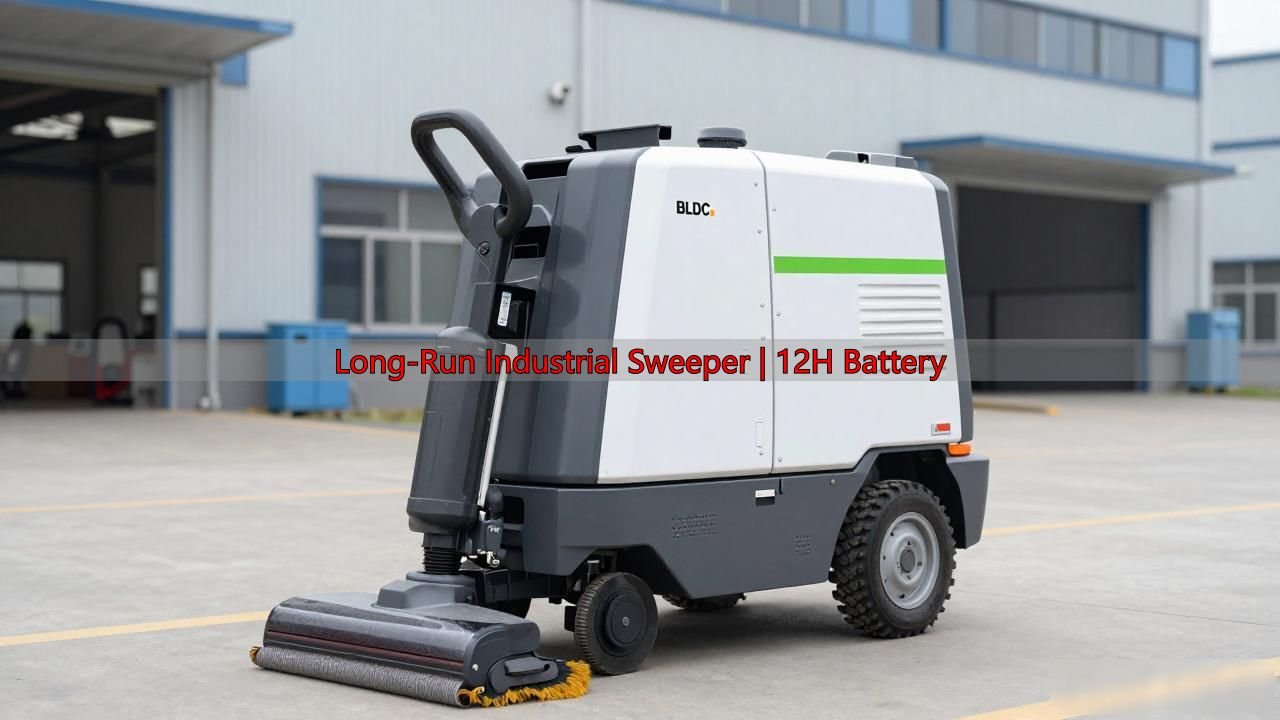
Regenerative braking on the BLDC drive. Every deceleration event feeds 3–5% energy back into the pack. Over a full shift with frequent stops at loading bays, that's roughly an extra 45 minutes of runtime for free.
Smart BMS with shift logging. The onboard controller records charge cycles, peak current, and ambient temperature. Your maintenance team gets a PDF shift report jeder 8 hours. No guesswork about when the pack needs a swap.
01.Real Numbers, Real Floors
A mid-size auto-parts distributor in Texas switched from two 8-hour lead-acid sweepers to one Tanjie TJJ-4000 LiFePO₄ unit . The results over six months:
Operating cost per square meter dropped from $0.031 Zu $0.019 (40% reduction).
Battery replacement cycle extended from 18 months to 4+ years .
The second operator was redeployed to floor inspection, saving $22,000/year in labor.
One machine. One shift. One invoice. The math is not complicated.
02.What to Ask Before You Sign
You're a decision-maker. You don't need a brochure. You need three answers:
1. What is the logged runtime at 100% throttle, 30 °C ambient, 80 kg/m² debris density? Not the "typical" number. The worst-case number.
2. What is the battery warranty in cycles, not years? Ask for 2,000+ cycles at 80% capacity retention.
3. Who handles export compliance and spare-parts shipping to my port? If the answer is "the factory in Hefei will email you a PDF," you don't have a partner. You have a transaction.
Anhui Tanjie International Trading Co., Ltd. handles all three. Customs clearance, CE/UL documentation, and a 48-hour spare-parts dispatch window for verified accounts.
03.Make the Call Today
The next time your sweeper parks itself at hour seven and your team walks over with a mop, that's not a maintenance issue. That's a design failure you've been paying for every single day.
Write to Anhui Tanjie International Trading Co., Ltd. this week. Tell them your floor area, your shift pattern, and your debris type. They will model your runtime, quote the battery configuration, and send a binding FOB quote within 72 hours.
One long-running machine beats two short ones. Always has. Always will. The question is just: are you still running two?